


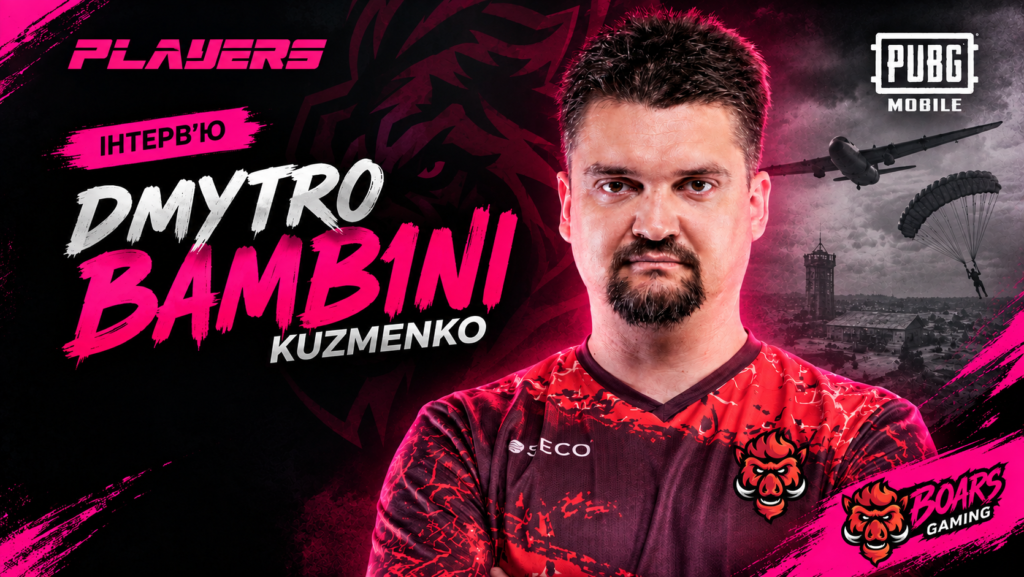
Today, September 18, marks the start of PMGO 2026 Season 2 - Western Europe Finals — one of the main international tournaments of the PUBG Mobile season. Among the participants will be the Ukrainian organization Boars, which this time will perform with an international roster.
On the eve of the start, we spoke with Boars coach Dmytro «Bamb1ni» Kuzmenko about the team's preparation for the tournament, the progress of Snowix and Wagnerzada, the captain's role, decision-making under pressure, and the specifics of working with an international roster.
We also discussed the fight for PMGC 2026 points, responsibility to the Ukrainian audience, potential pressure in the final matches, and how the team copes with unsuccessful maps and tilt.
— Good day! You already have experience in major international tournaments. What did the team do differently this time during preparation for PMGO compared to previous major tournaments?
Hello! This time we tried significantly less to rebuild something right before the tournament. After previous international events, we already have an understanding of what works and what starts to break down when the lobby level and the cost of a mistake rise.
Therefore, preparation was more about repeatability: clear roles, scenarios for different game developments, alternatives if the initial plan doesn't work. That is, not coming up with even more solutions, but making sure that the solutions we already have can be consistently executed by the team under pressure.
— Recently, the roster has grown noticeably as a team. What, in your opinion, are you doing better now than before?
I would highlight two things here.
First — very big progress from Snowix specifically as a captain. He has become significantly stronger not only in terms of individual calls, but specifically in managing the team: understanding the game's tempo, taking responsibility for decisions, and how he leads other players through difficult situations.
For PUBG this is critical, because a good captain is not just a person who tells you where to drive. In many ways, he shapes how the entire team sees the game. And his growth has strengthened us overall very much.
Second thing — Wagnerzada's progress. Moreover, I wouldn't tie it to just one component. He has grown very comprehensively as a player: in decision-making, understanding situations, communication, and individual execution. Right now, he is a much more complete and consistent player than before.
And as a result, these things start working together: stronger in-game leadership plus individual player development give us a much greater shared understanding of what the team wants to do on the server.
— What is the main strength of this roster today — shooting, macro, communication, or the ability to make decisions under pressure?
If I had to choose one thing — I would say it's potentially decision-making under pressure. Shooting at this level is something practically everyone can do. Good macro by itself guarantees nothing either, because PUBG constantly creates situations that aren't in your initial plan.
The most valuable thing is how quickly the team can get information, correctly interpret it, and make a joint decision. That is precisely the direction in which we have grown the most.
— In PUBG Mobile, sometimes a player's decision right during a match can contradict what you prepared in training. At such moments, how ready are you to trust the player's own intuition?
Absolutely ready, provided there is information behind that intuition.
A game plan is not an instruction manual that cannot be violated. It exists so that the team has structure and a basic logic of actions. But PUBG constantly creates situations that are impossible to predict in advance. Furthermore, what we call a strong player's intuition is very often actually situation recognition based on hundreds or thousands of previous games.
My goal is not to teach players to always act according to the game plan. I want them to understand the game and the logic of our actions so well that at the moment when there are conditionally a hundred options in front of them, they can independently find the right one. Sometimes this decision will fully correspond to what we prepared, and sometimes — on the contrary — it will require stepping away from the game plan.
So if a player at a specific moment has information and sees the right decision, I want him to be ready to make it, rather than thinking: "The coach told us to do it differently."
— The final format is 18 matches over three days. Will you try to play as consistently as possible from the first map, or are you ready to take risks at the start to immediately build an advantage?
We don't want to play the standings table after the first or second map.
18 matches is a fairly long distance. So intentionally raising the risk just to look good in the standings after day one doesn't make sense to me. But consistency for me doesn't mean passivity. If the game gives an opportunity to take a strong position, make an aggressive move, or score a lot of points — we must take advantage of it.
The task is not to avoid risk. The task is not to take bad risk.
— What if after the first day the team finds itself not where you planned — will you change the approach or continue playing according to the initial plan?
First, we need to understand why we ended up there.
Six matches is already information, but not yet a reason to frantically rebuild the whole game. There is a big difference between a team systematically making wrong decisions and a situation where right decisions several times resulted in a bad outcome. If the problem is structural — we will change it. If it's just poor execution or dispersion over a few matches — breaking a working system because of that would be a mistake.
For me, one of the coach's functions at such tournaments is precisely to distinguish one from the other.
— Is there a team at this final that you are particularly interested in playing against specifically from a tactical point of view?
Probably Hayatara Crew. They have quite specific behavioral patterns on the map, because of which the community's attitude towards them is still, let's say, not entirely unanimous. From a tactical standpoint, they are really interesting to watch. Sometimes it feels like macro-wise they already know the next step before everyone else has even made it. [smiles]
So I'll be especially interested to play against them directly in the finals and see how well these patterns work in direct interaction with us.
— And what type of team, on the contrary, is the hardest for you from a tactical standpoint? Is there a playstyle against which Boars has to adapt the most?
It's usually not hardest against teams that are just very strong mechanically. You can at least prepare for that in a straightforward way.
Much more uncomfortable are teams that constantly change tempo and don't give you a consistent pattern: today they play one rotation, next match in a similar situation they do something completely different, they might give up a logical move or, on the contrary, enter space very early where you don't expect them.
Against such an opponent, it's harder to work through preparation — there, much more depends on how well the team reads the game directly in the match and how quickly it can adapt.
— This tournament is important not only because of PMGO itself, but also in the context of the race for PMGC 2026. Does the team feel extra pressure because of this, or do you try not to think about long-term points at all?
We understand the significance of these points and the overall situation of the season. It would be strange to pretend that PMGC doesn't exist for us.
But during the matches themselves, this information doesn't help you in any way. A player cannot make a better decision in a specific zone just because he is thinking about the PMGC table.
So for the coaching staff, this is part of the strategic context of the season. For the players during a match, the task is much simpler: the next right decision, the next fight, the next map.
— There will be many Ukrainian players at the tournament, and Boars is the only Ukrainian organization, although your roster itself is international. Do you feel any special responsibility towards the Ukrainian audience specifically as representatives of a Ukrainian organization?
For me — absolutely. Boars remains a Ukrainian organization regardless of how many different flags are next to our players' nicknames. And to me personally, it's important that on the international level, Ukraine stands next to the club's name.
But I don't want to turn this into an additional psychological burden for the players. They shouldn't go into a match thinking they are obligated to prove something to someone right now. The best way to represent Ukraine is to do your job professionally and show results.
— Let's imagine the last day: before the final match, Boars are literally a few points away from top-2. As a coach, will you tell the team to play as cautiously as possible for the sake of the result, or will you allow them to act in their usual style?
It will depend on the table, the map, and how many points exactly we need.
I definitely won't say: "Guys, let's play cautiously." That is a very dangerous mindset because the team starts playing not PUBG, but protecting its place in the table.
But equally wrong would be ignoring the tournament situation. If we need a specific result for top-2, we must understand what level of risk is actually necessary for us.
So I won't break our style. But risk management in such a match will already depend entirely on the math before the last map.
— You are Ukrainian, and the Boars roster is international. How difficult is it to work in such a group from a communication perspective?
Actually, there's an interesting point here: in matches, the team communicates in French. That means as a coach, I had to adapt to that specifically. I can't say I've learned French as a language, but during my time working with the team, I've already built up a pretty good level of understanding of game French — terms, short commands, reactions, conversation context.
In a match, it's important for me not just to hear individual words, but to understand what is happening inside the team right now, who gave what information, and how others reacted to it. Outside the game, everything is much simpler — we communicate in English. And there are no serious issues here: English is English everywhere, we understand each other fine and can calmly discuss the game, decisions, or any work matters.
So the biggest challenge for me wasn't the roster's international nature as such, but specifically learning to understand their internal French communication during games well enough.
— PUBG Mobile is a game where one bad match can heavily impact the next one. How does the team react to such situations? Are the players more inclined to support each other and recover quickly on their own, or do you as a coach have to work with them separately to prevent tilt and bring the team back to the right psychological state?
I generally try to separate two things: a mistake that needs to be fixed, and the emotion after that mistake. If after a bad map we spend fifteen minutes proving to each other who is to blame, we will start losing the next map before the plane even takes off.
Therefore, during a match day, the review should be very short: what happened, is there something that needs to be changed right now, and then reset. A detailed analysis can be done after the matches. The players are already much better at bringing each other back into a working state on their own, and that is very important. But my task is to see the moment when a bad match stops being just a bad match and starts affecting subsequent decisions.
Because the problem with tilt isn't just emotions. The worst starts when, due to a previous mistake, the team in the next game becomes either too cautious or, on the contrary, tries urgently to "make up for it."
— Thank you for agreeing to the interview. Good luck to you!
Thank you!
Starting today, Boars will begin their performance on the international stage. Ahead of the team are three days of final matches, 18 maps, and a battle not only for the PMGO result itself, but also for crucial points in the seasonal race for PMGC 2026.
Whether the team will be able to execute their preparation on the big stage — we will see right from the tournament's first matches. Follow Boars' performance with us and support the Ukrainian organization on the international arena!
Matches start on September 18 at 19:00 (Stream)
It is also worth noting that Ukraine has the largest representation among all participating countries in PMGO 2026. Out of 83 tournament participants, 15 are Ukrainians.
As a reminder, hiro is leaving NAVI and moving to Team Heretics before the start of VCT 2027.