


Players conducted an interview with Artyom Odintsov, who is the CEO of AWERTI, a company that объединяє провідні аналітичні платформи Streams Charts and Esports Charts.
In the interview, we discussed the development of live streaming in Ukraine, the “Lebiga effect,” the competition between official studios and co-streamers, Stream Awards 2025, and the prospects for the development of Ukrainian streaming.
Hello, Artem. First of all, I’d like to ask you to introduce yourself.
Hi, my name is Artem. I’m the CEO of AWERTI, which includes Streams Charts and Esports Charts. We’ve been operating in Ukraine for almost ten years now, specializing in live streaming and esports analytics.
How would you assess the state of co-streaming in Ukraine? Is it already a formed market segment, or is it still in an active growth phase?
It’s definitely not fully formed yet. I would say it’s in an active growth phase, just like the entire Ukrainian-language Twitch and YouTube ecosystem. Right now, the main focus is on increasing the number of co-streamers and the amount of content they generate. For example, in our region, for Tier-1 CS or Dota 2 tournaments, we currently have one, at most two co-streamers. For comparison, in Brazil or the Philippines, each Tier-1 Dota 2 tournament has 10–15 co-streamers working on it.
In Ukraine, coverage remains inconsistent:
- co-streaming covers approximately 10–20% of tournament content;
- its share of total viewership is usually around 10–15%.
However, there are exceptions during major events. For example, The International was covered in full, and co-streaming’s share reached about 30%, thanks to Ghostik.
What needs to be done to increase this number in the context of Tier-1 tournaments? Is the issue that people don’t want to do it, or that they simply don’t have permission?
First of all, many people still confuse co-streaming with piracy, although that’s no longer the case. In the context of Dota, there is Dota TV, where streamers like Ghostik can legally broadcast matches, create shows, and cover games featuring Ukrainian teams, which makes him the most popular Dota co-streamer. During The International, he covered 100% of the broadcast. As far as I remember, TI had one of the highest percentages of Ukrainian-language co-streaming.
Regarding Counter-Strike, we see good interaction between Leb1ga and Maincast: coverage of NAVI’s matches at Tier-1 tournaments allows Leb1ga to generate 10–15% of all Ukrainian-language tournament views. He forms the core share of Ukrainian co-streaming in the discipline.
However, coverage is still not systematic:
- fewer than 10 hours of broadcast per tournament on average;
- mainly streams only NAVI matches;
- approximately 15–20% of total Hours Watched at specific events (Krakow, Cluj).
Yes, these are not the numbers of European co-streamers like ohnePixel, or the U.S. market, where in Valorant co-streaming can reach 50–60% thanks to collaboration between studios and publishers. But in the context of Ukraine, this is fairly solid coverage.
To increase the scale, the key is building structured cooperation between rights holders and co-streamers. In this context, we’re referring to Maincast, because one important factor is competition. I’m aware of cases in Europe where similar situations were resolved successfully. Mutually beneficial solutions can be found: sharing advertising revenue, or agreeing that it’s profitable for studios to give the group stage to co-streamers while keeping the playoffs for themselves.
Another point is that it’s easier to grow through Tier-2 and Tier-3 tournaments. While Tier-1 has only a handful of co-streamers, at lower levels we already see dozens (for example, Leniniw) and broadcasts featuring Ukrainian teams such as Lazer Cats, Favbet, Leo Team, and others. This is a good way to grow and train a streamer’s community to tune in to matches and watch esports.
On average, co-streaming in Ukraine accounts for around 10–15% of a tournament’s total viewership. However, it’s important to understand the context.
Essentially, that 10–15% is mostly generated by a single streamer in each discipline — in Dota 2 it’s Ghostik, and in CS it’s Leb1ga. In other words, nearly all Ukrainian co-streaming is concentrated around one creator, and for a single channel, that’s a fairly substantial share.
At the same time, they don’t stream every single match of a tournament. The current focus is mainly on matches featuring Ukrainian teams. Because of this, their overall impact is limited by the scope of their coverage.
A telling example is The International, when Ghostik covered 100% of the tournament matches. Co-streaming’s share then reached about 30% of total Ukrainian-language viewership. This demonstrates the segment’s potential: when full coverage is provided, the impact of co-streaming grows significantly.
Accordingly, if Ukrainian co-streamers systematically covered all tournament matches, their contribution to total viewership would be much higher. For now, the key driver of views remains matches featuring Ukrainian teams, and that is where the primary focus lies.
Doesn’t this create a threat to the studio itself? Won’t they lose viewers by giving out CS broadcast rights?
This works like the Pepsi and Coca-Cola marketing model: two refrigerators placed side by side don’t create competition risk — they actually increase overall sales. Leb1ga plus Maincast doesn’t mean Maincast is losing audience. It means that 30–40% of viewers who would otherwise be watching let’s plays or the Just Chatting category come to watch the match instead. In this case, the streamer brings a new audience into esports, expanding it. In the long run, this raises interest both in esports itself and in the studio that acquires the broadcast rights.
It’s also worth noting the audience shift between platforms. We see that YouTube is gradually strengthening its position even in live broadcasts. For example, during IEM Krakow, Maincast’s YouTube numbers were 15% higher than on Twitch.
At the Cluj-Napoca tournament, YouTube also outperformed Twitch — by approximately 10%.
This signals a shift in consumption behavior: YouTube is no longer just an additional platform, but a full-fledged driver of Ukrainian-language esports viewership.
We should also consider the role of TikTok as a channel for attracting new audiences and expanding reach around tournaments.
What metrics should a studio focus on when deciding whom to grant broadcast rights to? Peak viewership during top matches, or audience stability between tournaments?
One of the key indicators is audience overlap between the streamer and the studio. This data is covered by platforms such as Streams Charts and Twitch’s internal panel. If we look at streamers with audiences in the tens of thousands, such as thetremba, Leb1ga, and others, their audience overlap with the studio is only about 5–15%. This means that by bringing in their viewers, they are delivering a new audience that previously did not watch esports or Maincast broadcasts.
On the other hand, a streamer who already consistently streams esports — for example, Leniniw — may have an 80–90% overlap with Maincast. Such a streamer may be less interesting for the studio, since it’s essentially the same audience.
Is there a difference in audience behavior on a regular stream compared to co-streaming NAVI matches?
Yes, and it’s quite significant. Audience engagement among co-streamers is at least twice as high as on studio broadcasts. For example, during NAVI matches, chat engagement on Maincast is around 5–6%, while for Ghostik or Leb1ga it reaches 10–12%. Co-streamer audiences are more active in chat, more responsive to calls to action — whether that’s joining Telegram, voting, participating in giveaways, or any similar activity. This is highly valuable for brands, whether in Ukraine, Europe, or anywhere else, because chat messages and links receive significantly more interactions and clicks.
During IEM Krakow, NAVI matches had on average about four times more viewers than matches of the most popular team at the tournament that did not involve NAVI.
For example:
- The average viewership (AV) of Team Vitality matches was 13.2K viewers;
- NAVI matches gathered over 50K AV.
That’s roughly a +300% difference in favor of NAVI.
At the Cluj-Napoca tournament, the situation was slightly less extreme, but the gap remained very noticeable:
- Team Vitality — 8.6K AV;
- NAVI — 25.6K AV.
In other words, NAVI matches attracted about three times more viewers (+200%).
What is currently stopping Maincast from granting rights more freely? Fear of market oversaturation?
There’s no real risk of oversaturation right now. The esports audience accounts for only about 8% of all Ukrainian-language live streaming. And that 8% is, more or less, concentrated around Maincast. Maincast itself is slightly below that figure, but we’re not talking about 60% or 70% of a single audience, especially if we include YouTube.
If we look at all of Twitch in 2025, esports accounts for around 25%, as far as I know. That’s not a small number — it’s solid — but it still means that three out of four people watching streams are not regular esports viewers. So if this gap starts to narrow — if audiences from Just Chatting or let’s play categories are gradually brought into esports — in the long run both studios and co-streamers will benefit.
So what is actually holding Maincast back?
I think the main issue is the limited number of Ukrainian brands. Right now, Ukrainian marketing is facing a problem: the number of brands and the demand for esports are significantly lower than before the full-scale war began. Many brands have redistributed their marketing budgets into different initiatives, with part of those budgets going to volunteer efforts and other priorities.
There isn’t a queue of sponsors waiting to enter. So there may be concerns that co-streamers could start “competing away” brands from official studios.
What if, for example, extended rights were granted in the same way they are to Leb1ga, where he is effectively required to watch the Maincast broadcast? In other words, the brands featured on Maincast’s broadcast are also present on Leb1ga’s stream.
That’s a good concept, yes. I support it, because a similar model is used in Valorant by Riot Games, and it’s a very successful approach. Valorant, in many ways, currently thrives thanks to major co-streamers.
There’s no real issue with that model. I can see that they are starting to implement something similar in the context of the federation and the Ukrainian Championship tournaments that are currently taking place in Dota, where co-streaming has been allowed. It’s a positive step — an opportunity for smaller streamers who need content and want to prove themselves. It’s a great path for them to commentate Ukrainian team matches at the Ukrainian Dota and CS Championships. Perhaps they are also assessing how many co-streamers are actually willing to create content.
There is, however, a broader issue when a co-streamer grows into a full-fledged studio. Europe has already faced this. A vivid example is Brazil — Gaules, who started as a co-streamer and is now a fully established media entity in Brazil, operating multiple channels with rights on YouTube and Kick. Other studios in Brazil struggle to compete with him because he is a national media star.
Similarly, in Europe, ohnePixel posts significant numbers at Tier-1 tournaments and presents strong competition to studios. So there is a risk that someone like Leb1ga or Ghostik could eventually build their own studio and start competing directly. The risk lies in the fact that when they stream a tournament, the audience watches it — but when they don’t, that audience may not come to the official channel at all.
These risks exist, but the key is working properly with co-streamers. In my opinion, one important element is allowing co-streamers to stream the group stage, while for the playoffs you either invite them as studio guests or restrict them from streaming the final or key semifinal and final matches. This creates an audience flow from co-streamers to the official studio.
In our case, Maincast is the rights holder. In Europe, with co-streaming in League of Legends or Valorant, Riot invites co-streamers directly to the arena, giving them the opportunity to create media content on-site. That generates a major media boost — through YouTube highlights, TikTok clips, Instagram content. Key moments or “wow moments” from the broadcast can be turned into five or six different clips by different co-streamers. It looks cohesive when everyone features the same brands and aligned content.
In Ukraine, such a rights model isn’t really feasible yet. But co-streamers can still be invited to become part of the studio.
What are the main trends you see on Ukrainian Twitch in the coming years? What defined 2025, and what might emerge in 2026? What could appear, grow, or potentially become the peak of 2026?
The most important element is content quality. In 2025, we saw a lot of shows, марафони (marathons), and various collaborations between streamers. This became especially noticeable with the expanded nominations at the Stream Awards. We will obviously see more of this content, because streamers have discovered the niche of adding “wow elements” to their broadcasts — marathons, show formats, and similar projects.
I hope there will be more of this, along with growing competition. These projects will develop their own brands and partners, and streamers will be able to attract sponsors directly into their content.
That, in turn, will help take marketing to the next level, because streaming and live streaming as a whole are forms of influencer marketing — and in Ukraine, influencer marketing is still not being fully leveraged.
In 2022, we saw a sharp rise in Ukrainian Twitch. Is this growth process continuing? In 2022, we saw a sharp rise in Ukrainian Twitch. Is this growth process continuing?
Every year sets a new record. I think that’s obvious. We released a report with the exact growth figures. The growth continues because more streamers are switching to Ukrainian-language broadcasts. There are still cases of streamers and audiences transitioning from Russian-language broadcasts to Ukrainian ones.
In 2023–2024, we saw that a fairly large portion of Dota and CS esports audiences were watching Russian-language studios. Today, that trend has decreased by 2–3 times. However, part of that audience still follows co-streamers in the Russian-language segment. One of Maincast’s objectives is to attract that segment to Ukrainian-language broadcasts and thus grow the audience.
Each new quarter and each new period brings new records. Including the first quarter of this year — so far, the trend shows we are approaching the records of previous years.
I’ll add a good example: yesterday there was Lachen’s first Twitch stream — about 4,000 viewers on his debut broadcast. I don’t remember how many hours it lasted, but it’s a good example of bloggers entering the Ukrainian-language segment. Last year, one of the discoveries was valentinopradagucci’s broadcast, which also brought a new audience into the ecosystem. He gathered his community and is now represented in one of the Stream Awards nominations.
We’ve also seen cases like Pivovarov and OTOY joining Twitch and streaming music content. So the key point in the Ukrainian segment is that streaming is no longer just Twitch — it now includes YouTube, TikTok, Instagram Live, and more.
If we talk about Twitch specifically, yes, it’s growing — but Ukrainian-language YouTube is growing even faster. This is largely due to Suspilne’s broadcasts on YouTube, including Olympic coverage and various sports events. The Eurovision National Selection is also streamed on YouTube and gathers hundreds of thousands of viewers.
All of this attracts not only younger audiences to live streaming, but also older viewers who previously consumed mostly political and news content and are now watching gaming content, reviews, and much more.
Overall, in 2025, Ukrainian-language live streaming accumulated over 319.1 million hours watched. The average concurrent viewership reached 36.1K viewers, and the number of unique channels totaled 56.4K. All three metrics grew by approximately 2.2% compared to the previous year.
The total airtime of Ukrainian-language broadcasts in 2025 increased by 17.3%. This growth significantly outpaced other metrics because more smaller channels appeared — despite long broadcast hours, they have moderate audience reach.

The total peak concurrent viewership of Ukrainian-language broadcasts in 2025 reached 923,139 viewers — a 0.23% increase compared to the previous year. Although the change is small, it still represents a new record for Ukrainian-language live streaming. Notably, in both 2024 and 2025, the maximum peak in the Ukrainian-language segment was recorded on New Year’s Eve during the President’s address.
YouTube remained the most popular platform for Ukrainian-language broadcasts, accounting for 78.8% of total hours watched. In 2024, its share was 83.2%, but throughout 2025 it decreased by 5.1% in favor of Twitch. Other platforms combined accounted for less than 1.5% of total hours watched.
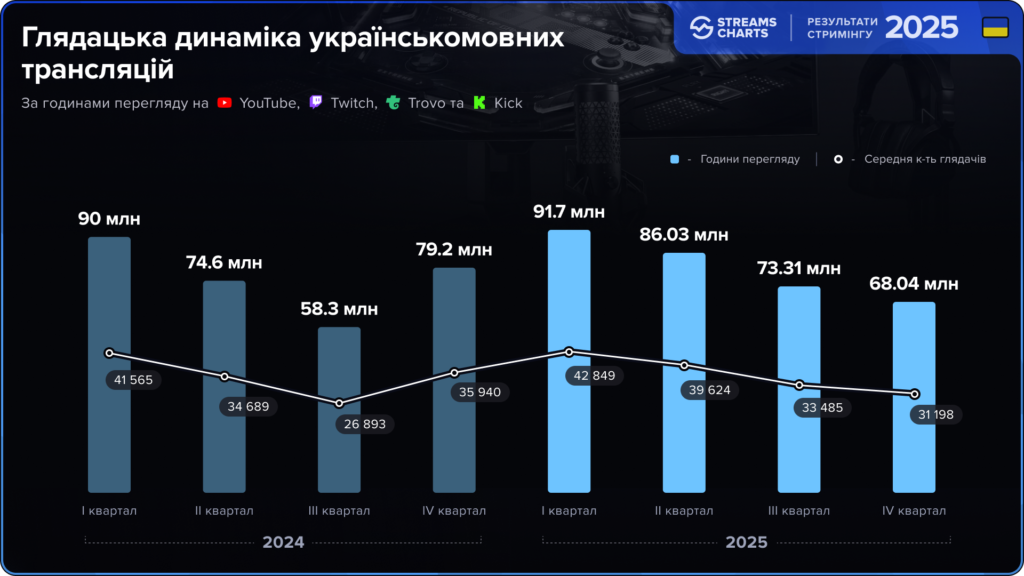
The first quarter of 2025 was the most productive for Ukrainian-language broadcasts — over 91.7 million hours watched in three months, nearly matching Q1 2024.
In recent years, the third quarter has typically been the least productive for Ukrainian-language broadcasts, due to seasonality and external factors such as rolling blackouts following Russian attacks on Ukraine’s energy infrastructure.
Previously, the fourth quarter would show a rebound in hours watched. However, in 2025, Q4 continued the downward trend and ultimately recorded the weakest performance of the year. This was primarily due to intensified infrastructure strikes and mass power outages in Kyiv and other regional centers of Ukraine.

YouTube and Twitch maintain a clear content balance in the Ukrainian-language live streaming segment. On YouTube, non-gaming content dominates entirely — including news, politics, and sports broadcasts. In 2025, non-gaming content accounted for 93.2% of YouTube’s Ukrainian-language hours watched, largely driven by 24/7 news channel streams.
However, gaming content on YouTube did grow over the past year — from 3.4% to 6.7% — mainly due to esports tournament coverage.
Twitch remained the main platform for gaming and esports coverage in 2025, although the share of gaming content in the Ukrainian-language segment decreased from 78.6% to 68.9%. Non-gaming creators are becoming increasingly popular on Twitch — IRL streamers, bloggers, and stand-up comedians.
The top three categories on Twitch remained the same, but now Just Chatting leads the ranking, accounting for 24.7% of total Ukrainian-language hours watched. Counter-Strike and Dota 2 rank second and third with 21.4% and 13.7%, respectively.
Which category is currently leading?
At the moment in Ukraine, News & Politics is the leading category if we look across all platforms. Next comes entertainment, gaming, Just Chatting, and similar formats.
If we focus specifically on gaming categories, Counter-Strike leads across all platforms. The second place differs depending on the platform. On Twitch, it’s Dota, while on YouTube it’s World of Tanks. WoT consistently ranks among the top three games across all platforms, since the tank community in Ukraine is quite large. Many players participate in tournaments and stream a significant number of matches.
As of the end of February 2026, the leading streamers (excluding organization channels, across all platforms in Ukrainian) are:
- Dota 2 — Ghostik: 222,592 hours watched
- CS — Leb1ga: 314,659 hours watched
- Just Chatting — Leb1ga: 413,752 hours watched
- Gaming — The Roman: 17,920 hours watched
- News & Politics — Danya UA: 294,985 hours watched
How dependent is Ukrainian Twitch in the gaming segment on major international events?
It’s less dependent on events themselves and more dependent on NAVI’s participation or simply on Leb1ga going live on any given day.
If you look at the graph of Ukrainian-language Twitch broadcasts, spikes are clearly tied to NAVI matches or to Leb1ga starting a stream — even when it’s not esports-related, just a regular broadcast. These are very noticeable boosts in viewership.
In Maincast’s case, viewership can grow from 5–10 thousand viewers to 30–50 thousand, with record peaks reaching 100 thousand viewers.
In Leb1ga’s case, when regular streamers gather 3–5 thousand viewers — and at certain times of day, even 1–2 thousand may be the maximum — his streams launching at 10 thousand viewers, or cases where he gathered 50–60 thousand, stand out significantly.
So when we talk about global esports tournaments or leagues — for example, DreamLeague happening right now — moments without a Ukrainian team or without particular hype tend to be fairly ordinary. The content generation level simply matches the baseline output of Ukrainian streamers who create content 8–10 hours a day.
What data interests brands and partners the most today? Is it reach, retention, or something else?
It’s a fairly complex question because different brands have different needs.
There are marketplace-style solutions — for example, in the Ukrainian segment, StreamAdvisor operates largely on a CPM model, where ads are displayed and converted into revenue for streamers. In that case, the main goal for brands is impressions.
At the same time, many brands work on CPC or CPA models — meaning clicks or app installs. Unfortunately, these are harder to track and are not particularly favored by streamers, because they limit guaranteed payouts. Streamers need to actively drive their audience to click, install, visit a website, or use a brand’s service.
So for streamers, brand exposure remains the most stable and convenient model. For brands, however, activations, clicks, and measurable actions are often more important.
Consistency in content output is probably one of the key elements for brands, because it builds steady brand recognition and allows them to develop a community around the creator.
As for demographics, within Twitch live streaming, the audience is currently fairly homogeneous. It’s difficult to clearly separate distinct cohorts or say that one streamer has an older audience and another a younger one. The audience is growing but largely concentrated within the same broad segment.
A significant portion belongs to esports, since esports was one of the first major drivers of growth in the Ukrainian segment in 2022. Another part consists of viewers interested in let’s plays and gaming content. There’s also a segment that transitioned from Instagram and TikTok, attracted by show-style content.
By show content, I mean formats created by streamers like Leb1ga, thetremba, and similar creators. For example, “Mafia” with streamers is essentially a show format. It has its own audience cohort — people who tune in specifically to watch that live show, rather than spending the evening watching YouTube or short-form entertainment videos.
So, here's a question. There's a Ukrainian streamer who streams 5 days a week for five hours with an online audience of 100 people. How much can they earn per month?
I think somewhere around $200–300 is a realistic price per month. We're talking about advertising appearances here. As far as I remember, the current rate is approximately $2 per thousand impressions. At the same time, the streamer segment commands a fairly high rate.
In the European and American segment, there's roughly a price per viewer. And that price is approximately one dollar per viewer. So when we talk about a streamer with, say, a thousand viewers, their income is probably at least a thousand dollars minimum. The American segment has already pushed the figure from $4 to $5 per viewer, the European segment can range around $2–4, and the Ukrainian segment generally sits at one dollar per viewer — that's a realistic rate for stable earnings. The problem is precisely the number of brands, engagement levels, and so on. We don't have 100 brands in the market that invest monthly in advertising on Twitch. We have about a dozen brands that do this.
I just opened Twitch right now, and in live streams we have a Maincast Counter-Strike broadcast with around 1,200 viewers, then there's DraculaN, a co-streamer of a tournament in Romania, with 200 viewers, then guthriee with 174 viewers, then Battalay with 124 viewers, and after that — 40, 40, 30, 20, 19, 18 viewers. Effectively, among those who are earning, you could start with guthriee, because Battalay, as far as I know, doesn't earn on his Twitch channel.
Yes, including YouTube, there are already 15 people currently online with more than 100 viewers. 15 is no longer 3 or 2, as we used to say. If we now look at YouTube, Sh0kerix is streaming Tanks with 500 viewers right now, which is a lot. OLDboi has 360 viewers, Ukrainian Geek has 300 viewers, and a number of other channels have around 100 viewers. As I mentioned, it's not just Twitch alone. There's also YouTube, which makes a very significant contribution.
If we focus on the metric of more than 100 Average Viewers (the average number of viewers per stream), then as of February 2026 in Ukraine the following was recorded:
- 400 streamers (total across all platforms and all categories, including politics, military reviews, entertainment content, etc.)
- 87 streamers (Twitch)
If the Average Viewers metric is 50–100 viewers, then for February 2026:
- 268 streamers (total across all platforms)
- 86 streamers (Twitch)
In general, I have a thesis somewhere regarding platforms — it is a mistake not to stream on YouTube at this point. And precisely on the question of what streamers do to earn more, what actions they take: one of the actions of many streamers with an audience of around 50–100 viewers is to stream everywhere and create content on multiple platforms. They are more active across their media landscape, because they are interested in every viewer and in growing themselves by 5%, by 10% with each month, each day, and so on. That's why with streamers like guthriee, you can see that he is active on TikTok, on YouTube, on Instagram, on Telegram — everywhere. At the same time, we can see Lebiga, who is active nowhere except Instagram, which doesn't have much connection to his streams. That's because he isn't focused on growing his viewer base, whereas these other streamers are very invested in their own growth.
Can we say that Stream Awards is a kind of snapshot of the state of Ukrainian streaming? Is it something new for Ukrainian Twitch?
Is it a snapshot of the state of Ukrainian streaming? Probably, yes. In general, an awards ceremony is more of a social element. Since we are experts in the global streaming market — we analyze the American market, the European market, and the Asian market, we track events around the world, we analyze awards shows similar to ours but for global and American streamers — naturally our team and company was interested in showing the Ukrainian community and Ukrainian brands that there are Ukrainian creators on streaming platforms, to highlight them, to bring them into the PR spotlight, and to create some kind of marker of importance for this streaming scene, so that brands would start to trust a streamer once they've been nominated or have won in a category, and so on.
This works well for fairly mainstream, well-known brands — such as, among our partners, Pepsi and Lays, or KFC, for example — where a nomination and the highlighting of a particular individual in an awards ceremony gives them the understanding that they can be trusted, that the numbers are honest and have been verified by an agency.
You mentioned that CS2 is essentially number one everywhere, with the rest varying by platform. Could you please explain — if you highlight CS2 in the nominations, why don't you single out, for example, World of Tanks as a separate category?
Why don't we separate out Tanks? There are actually a lot of comments about Tanks — I think separating them out isn't necessary. You can read social media and see the reactions to nominations involving Tanks players. But you can't just drop the game from the conversation entirely either.
We were interested, in particular, in adding nominations for other games, and we also had a shortlist of nominations under consideration in the format of "Top Mobile Gaming Streamer." We would have liked PUBG Mobile or Mobile Legends to be included, but unfortunately the segment in Ukraine isn't large enough to have a meaningful selection. The nomination would have consisted of just two or three streamers, and beyond that we would have had a pool of streamers watched by 10 or 20 people, which isn't quite worthy of a standalone nomination.
CS and Dota are like two pillars of the Ukrainian segment that you can't ignore and can't merge into a single category. It's like comparing football and basketball and having only one nomination for "sports." Each segment has its own viewer audience and its own fan base, which is why they are separated as two distinct games.
Going forward, of course, if a new player emerges or there's a spike of hype around a particular game, we will consider adding a nomination for that game. This doesn't necessarily have to apply only to games — additional categories can be added as well. Last year, one of our nominations was called IRL, which included Just Chatting and all other similar categories. This year we called it Non-Gaming, meaning that everyone who creates non-gaming content was included in the top rankings and nominated in that category.
I think that within a year we may see Non-Gaming split into Just Chatting and streams from people who travel more, or people who cook on their streams, and so on. The more streamers there are in a given category, and the larger the audience, the greater the chance that the category will be broken out into its own separate nomination.
Is there any analysis of how the awards impact the subsequent growth of nominees and winners?
There's no direct analysis in the sense of "someone won and their viewership went up by 40%." But, as I mentioned before, the award is largely about legitimization among advertisers and public figures. That's why we invest resources in the PR space — to mention streamers, so that brands see their nicknames and names and pay attention to Twitch or YouTube. So our goal is more social in nature. As for how things currently work in the Ukrainian segment — how streamers find sponsors, how many approaches are made to which agencies — that's not really our territory. We don't monetize ourselves as an agency that services streamers, and at the same time, perhaps an award like this helps some agencies. But the primary goal is social: to raise awareness of streamers, so that someone comes along and asks, "What is Twitch and how do you advertise on it?"
Do you see your award moving to an offline format? And in general, which country's streaming market do you think Ukraine could compete with?
Right now, due to the ongoing military situation, we can't guarantee safety and gathering all the streamers is quite problematic. So for the time being we'll hold the award in an online format, to hold the ceremony and prepare the community for larger events.
We're looking at a similar award in Poland. It exists and can be considered a competitor of sorts. The Polish market in general is quite competitive with the Ukrainian one. In the context of esports, there are months when Ukrainian esports overtakes Poland. But at the same time, the Polish streaming award is quite record-breaking for the Eastern European region. In January, the Polish awards ceremony peaked at 300,000 viewers. Compared to Counter-Strike, which is the record-breaking game that draws 100,000 viewers, 300,000 for an awards ceremony is a very high number.
Overall, one of our goals is to bring the community together next year — possibly at a distance first — and eventually hold it in an offline format.
What matters most for a streamer's growth today — personality, consistency, or participation in major media events?
To put it briefly, all of these matter. Yes, but personality is especially important in the context where there is competition within a game. That's when it becomes critical. If we talk about consistency, we can see from Lebiga's case that consistency isn't necessarily important. In his case, personality wins out over regularity.
But consistency is important in the context of co-streaming, creating let's play content, reviewing new games, and so on. Participation in major shows and events is also important, because it gives people the opportunity to discover you — it's additional PR and helps a streamer create personal content for themselves.
In general, the French and Spanish-speaking segments can be taken as benchmarks for community building. In France, guys organize an event with 120 streamers offline and raise 16 million dollars in donations over 2–3 days — and afterward Macron writes about it on his social media. That's an example of their community. Or the Spanish-speaking segment — Ibai and his boxing matches in arenas, where they sell out entire stadiums and draw over 10 million viewers at peak during their streams — that too is a testament to their live-streaming community.
And I believe that's where Ukrainian-language esports should be heading. In terms of answering the question about what the next 3–5 years in live streaming might look like, I would like to see agencies that are currently absent. We don't have streamer agencies that handle contracts for streamers and service them the way it's done in Europe and America. We don't have squads, as far as I can recall — not counting the VTuber squad as a separate community, or the groups around top streamers. But there are no standalone communities that compete with each other or create collaborative content together.
In particular, shows need to grow beyond ordinary Twitch into shows designed for YouTube, TikTok, and similar platforms, generating a surge of additional audiences for their streams. This already exists in other countries. I think it's realistically within the next year or two that this will start to appear in Ukraine. For that to happen, what's needed is not so much sponsors as market players who are genuinely interested in realizing this vision and investing in the future — because over time it can grow into something much bigger. I would love to see, as in Europe where Ibai and other Spanish streamers have their own teams competing in franchise leagues, similar teams appearing for Lebiga and other major streamers competing in Tier-1 leagues. Their audiences would cheer for those teams, and we'd see the audience of a Ukrainian team exceed that of NAVI matches. And it's possible. It just requires someone to be genuinely interested and to build a plan several years in advance.