


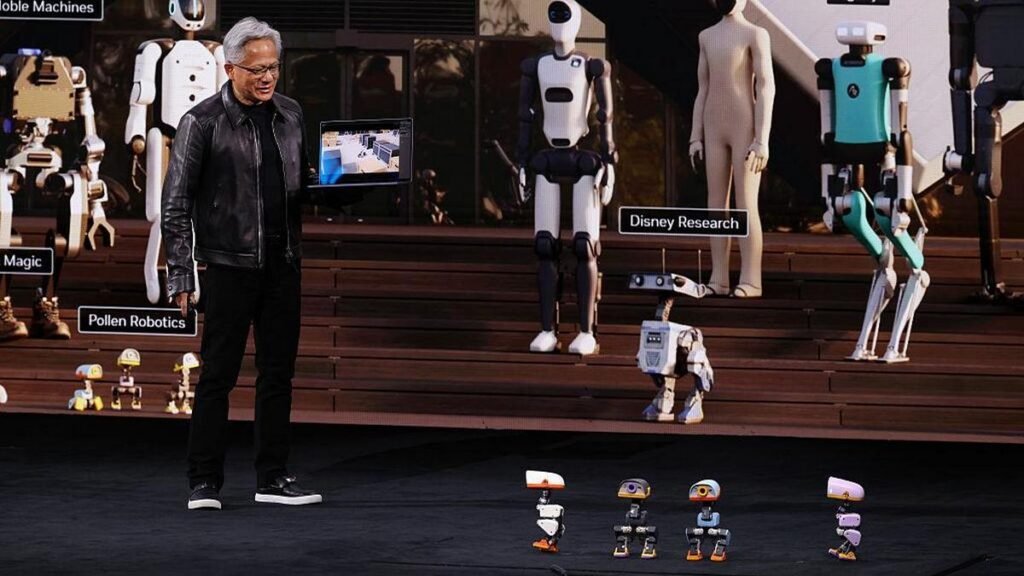
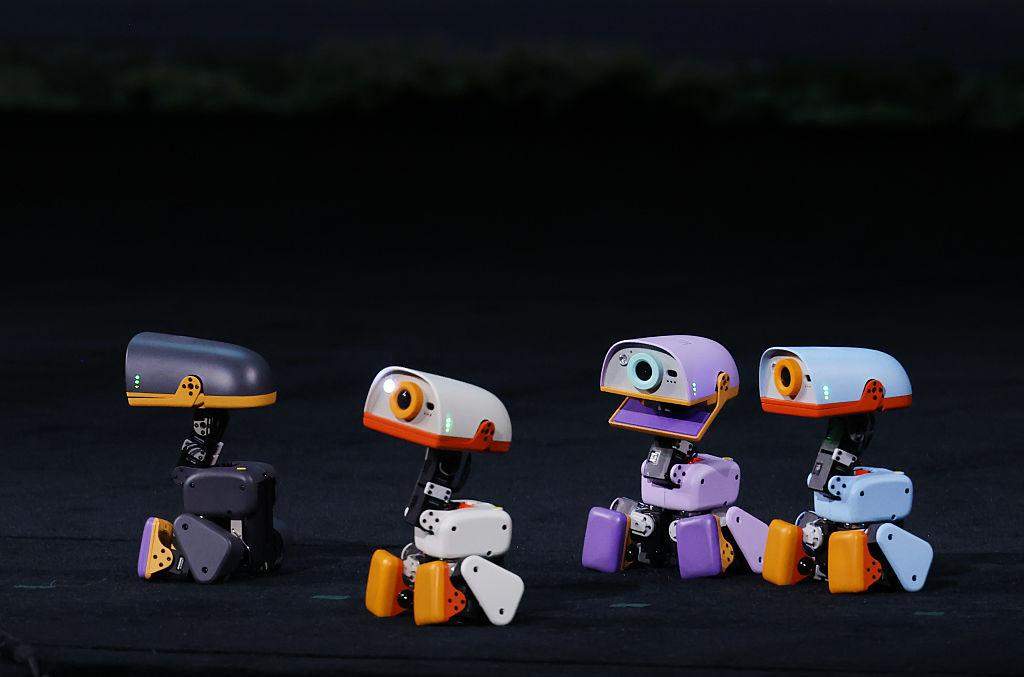
NVIDIA CEO Jensen Huang demonstrated the small Microduck bipedal robots at the GTC conference in Berlin, developed by Hugging Face and French robotics company Pollen Robotics. During the presentation, the robots independently walked onto the stage and followed Huang’s commands — sitting down, standing up, and even going to “sleep.”

Behind the entertaining demonstration was much more serious technology. NVIDIA showed how AI agents can help train physical robots using digital simulations. The process relies on Isaac Lab, Isaac Sim, and the Newton physics engine, which allow robots to practice their behavior in a virtual environment before transferring trained models to real hardware.
How AI Trains a Robot
During the demonstration, Huang showed a video in which an AI agent created an environment for training Microduck and launched a virtual version of the robot in Isaac Sim. The computationally intensive training process was then carried out using NVIDIA’s cloud resources.
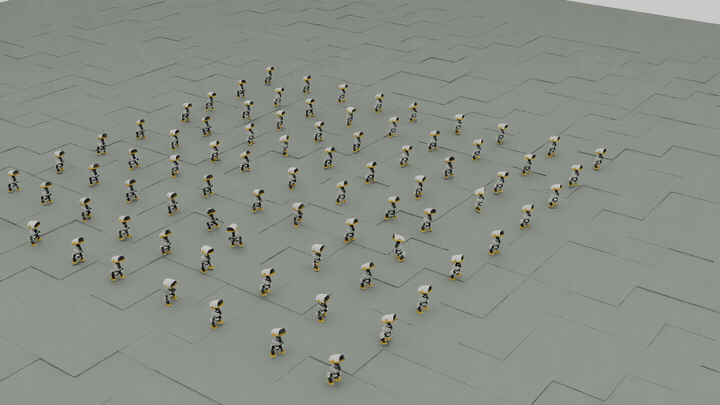
The resulting model was tested on RTX Spark, after which the trained behavior was transferred to a physical Microduck robot. This approach can significantly reduce the number of experiments that need to be conducted on real robots by allowing their skills to be tested in simulation first.
Hugging Face also published a technical description of the process. Developers can train Microduck in thousands of parallel simulations, then export the trained model in the ONNX format and run it directly on a physical robot.
What Is Microduck?
Microduck is an open-source bipedal robot developed by Pollen Robotics and Hugging Face for developers and students. It is approximately 25 centimeters tall and weighs less than one kilogram.
Its main feature is the openness of the platform. Users can train the robot to perform new physical skills, modify its behavior, and share their own models with other developers.
RTX Spark and Local AI
NVIDIA also paid particular attention to the RTX Spark platform, which is positioned as a new class of Windows PCs designed for running AI models and agents locally. The systems can offer up to 128 GB of unified memory and up to 1 petaflop of AI performance.
However, the Microduck demonstration does not mean that the entire robot-training process was performed locally on RTX Spark. The most computationally demanding tasks were handled in the cloud, while RTX Spark was used to work with the models and test the resulting behavior.
From Generative AI to the Physical World
The Microduck demonstration highlights one of the directions in which NVIDIA plans to develop artificial intelligence — Physical AI. The concept refers to systems that do not simply generate text, images, or code, but can also perceive their surroundings and control physical devices.
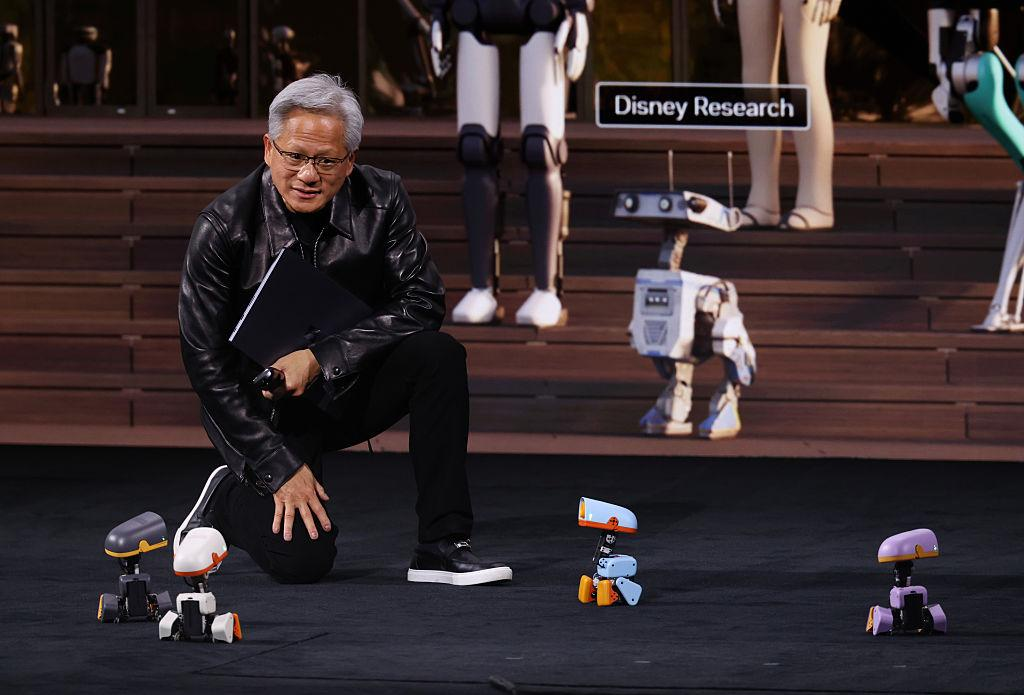
The combination of AI agents, simulations, and local hardware could potentially make it possible to create robots capable of independently learning more complex skills and transferring them from digital environments into the real world. This is how NVIDIA envisions the next stage in the development of robotics and agentic AI.
As a reminder, Hackers breach Capcom ID — leak affects nearly 11.8M accounts.