



NVIDIA is preparing to launch DLSS 5 on September 4 — the latest version of its neural rendering technology. The company promises to make lighting, materials, and other visual elements in video games more realistic through generative AI. However, even before its official release, DLSS 5 has already become one of the most discussed and controversial graphics technologies of recent years.
The reason is simple: instead of universal excitement, gamers have responded with memes, “DLSS 5 OFF / DLSS 5 ON” comparisons, criticism from developers, and discussions about whether artificial intelligence could eventually determine what modern video games are supposed to look like.

To understand why DLSS 5 has caused such a strong reaction, it is worth going back to where the technology began. NVIDIA originally developed DLSS as a way to use artificial intelligence to improve both performance and image quality. A game could render a frame at a lower resolution, after which a neural network would reconstruct it at a higher resolution.
With each generation, DLSS became more sophisticated. Frame Generation, Ray Reconstruction, and other tools appeared, allowing AI to take over an increasing amount of the work involved in producing an image.
DLSS 5 takes the next step. NVIDIA calls the new technology 3D-Guided Neural Rendering. According to the company, the AI uses information supplied by the game engine to enhance lighting, materials, and other elements of an already rendered scene.
And this is where the main controversy began.
One of the first demonstrations of DLSS 5 featured Resident Evil Requiem. NVIDIA wanted to show how significantly the new technology could improve lighting, skin, materials, and other details.
However, the reaction from some gamers was very different from what the company had expected. Instead of seeing “the future of graphics,” many users saw a character who appeared unnatural after being processed by generative AI.
The face of the main character received particularly strong attention. For critics, it became a symbol of the main concern surrounding DLSS 5: the technology can make an image technically more complex while simultaneously changing the way artists originally intended a character to look.

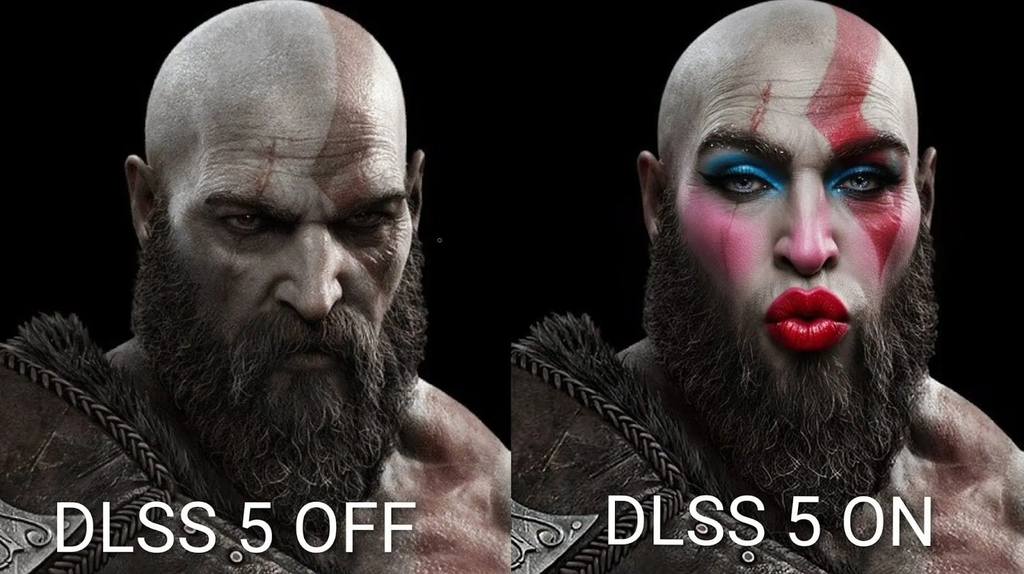
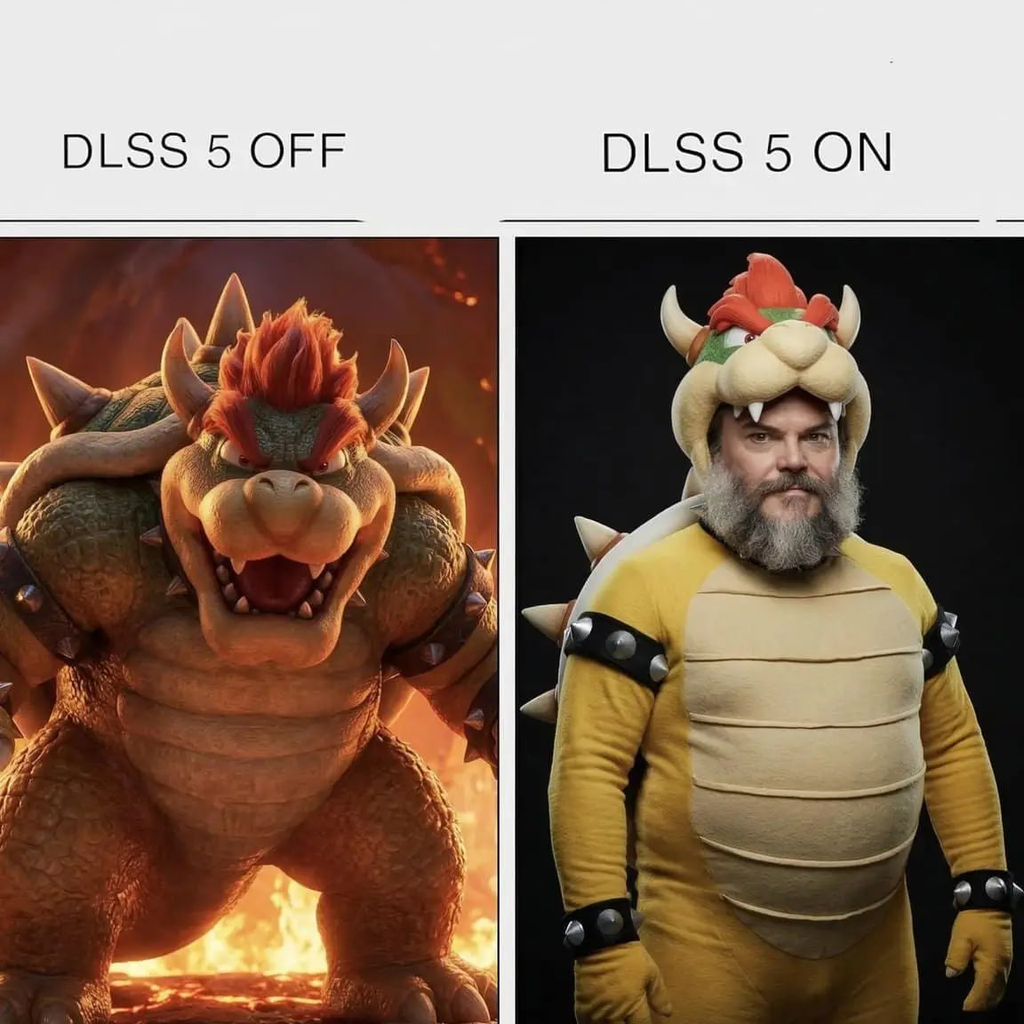
After the DLSS 5 presentation, social media exploded with parodies. Users began creating their own comparisons in the “DLSS 5 OFF / DLSS 5 ON” format, deliberately exaggerating the effects of generative AI.
In one image, a character or object remained unchanged, while the second version was made as “AI-looking” as possible: overly smooth skin, unnatural lighting, shiny materials, or strange details.
The meme quickly went beyond a single game. Know Your Meme has documented numerous variations of the format, which became a way of mocking concerns that AI-based rendering could make games look overly processed and increasingly similar to one another.


At first glance, it might seem that the entire issue comes down to “I don't like how the image looks.” In reality, the discussion is much broader.
A video game is not simply a collection of technical specifications. Artists spend years working on characters, materials, lighting, and color palettes. They deliberately decide how a particular scene should look and what kind of impression it should create.
That is why the arrival of technology capable of influencing the final appearance of a frame raises an important question: where does the artist's vision end and the algorithm's decision begin?


The question of artistic control has therefore become one of the main arguments made by DLSS 5 critics.
Another concern raised by critics is the possible spread of what could be called “AI realism.”
Modern games can have completely different visual styles. Resident Evil aims for cinematic realism, Borderlands uses comic-book stylization, Fortnite has its own colorful aesthetic, while some indie games deliberately embrace rough or retro visuals.
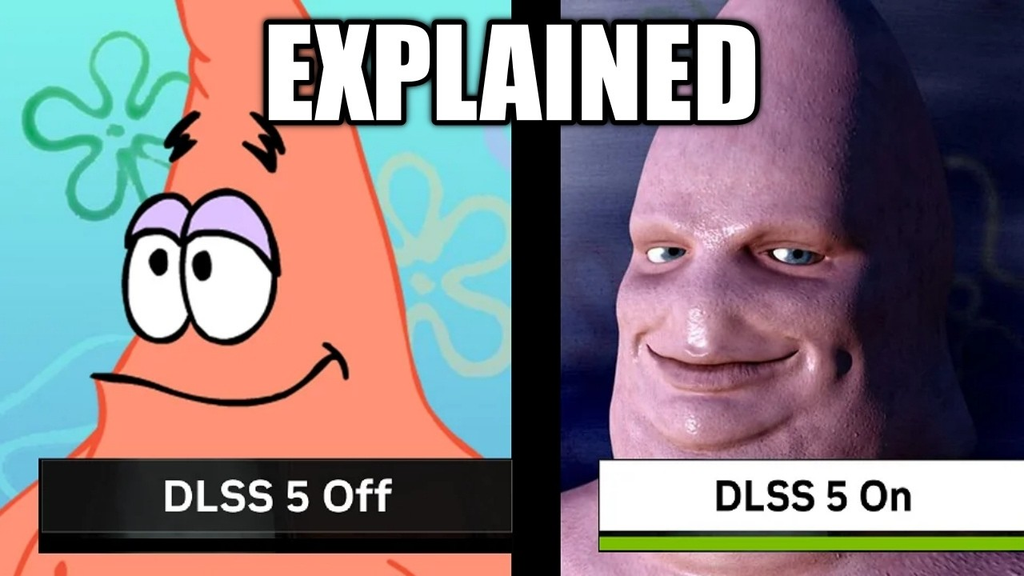
If the same AI technology becomes widely used to produce the final rendered image, there is a risk that very different projects could begin sharing similar visual characteristics. More shine, more realistic skin, cinematic lighting, and increasingly detailed materials could gradually become a kind of universal standard.
That is why critics worry that the development of AI rendering could not only make games look better, but also reduce the diversity of their visual language.
NVIDIA, for its part, argues that DLSS 5 is not supposed to function as a random image generator. The company says developers have significant control over how the technology affects individual elements of a scene.

Developers can use masks, adjust the intensity of the effect, and control specific areas of an image. NVIDIA also positions DLSS 5 as a tool designed to help realize artists' vision rather than replace it.
In theory, this means that the problems shown in the first demonstrations can be addressed through proper implementation and tuning.
This is why NBA 2K27, which will be the first game to officially support DLSS 5, is particularly important.
In this case, NVIDIA is trying to demonstrate a more controlled use of the technology. DLSS 5 enhances skin, hair, clothing, lighting, and environmental materials, while developers can control how strongly the technology affects individual parts of a character.
This is an important distinction because it shows the difference between what critics saw in the first demonstration and how the technology can potentially be used in a finished game.


It is easy to forget another important factor in this discussion: performance.
DLSS has traditionally been associated with technologies that help increase FPS. However, Neural Rendering requires additional computational resources, meaning that its use can come with a noticeable performance cost in certain scenarios.
This creates an interesting paradox: a technology historically associated with increasing performance can itself consume a significant amount of GPU resources in exchange for improved visuals.
That leads to a perfectly reasonable question: is the visual improvement large enough to justify the additional performance cost?
At the end of August, the situation became even more interesting. Components of DLSS 5 connected to an early version of NBA 2K27 appeared online, after which modders began experimenting with the technology in other games.
Neural Rendering was tested in projects such as Skyrim, Cyberpunk 2077, GTA V, and Control. This allowed users to see how the technology behaved not only in NVIDIA's carefully controlled demonstrations, but also in completely different game environments.


These experiments further fueled the discussion. In some cases, the results were genuinely impressive; in others, the effect was so aggressive that the image began to resemble typical AI-generated artwork.
At the same time, early modifications demonstrated how demanding the technology can be from a performance perspective. In one experiment, the frame rate reportedly dropped from around 90 FPS to 29 FPS.
Despite all the criticism, it would be wrong to view DLSS 5 simply as another AI filter. If the technology works as NVIDIA describes, it could change the way game graphics are created.
Today, developers create models, textures, materials, lighting, and other elements, after which the GPU traditionally renders the scene. In the future, part of this work could be handed over to neural networks, which would help produce the final image.
This opens up enormous possibilities. Developers could potentially create more complex scenes, more realistic lighting, and more detailed materials without having to increase the amount of traditional graphical resources at the same rate.
In this sense, DLSS 5 really could mark the beginning of a new era. NVIDIA itself describes the technology as a new rendering stage that complements traditional rasterization, ray tracing, and path tracing rather than replacing them.
The problem could arise if AI-based rendering becomes such an important part of the graphics pipeline that developers begin creating games with the assumption that a neural network will “finish” the final result.
Studios could gradually move from creating the highest-quality finished frame possible toward creating a kind of “foundation for AI.”
And that would be a fundamental change. The GPU would no longer simply be a device reproducing a world created by artists. It would become, at least partially, a participant in creating that world.
There is no definitive answer yet.
DLSS 5 could become an important step in the development of real-time graphics if developers receive enough control and learn to use the technology without damaging a game's artistic style.
But the first reaction from gamers has already shown what they are afraid of. The “DLSS 5 OFF / DLSS 5 ON” meme did not become popular by accident: it reflects concerns that the future of graphics could turn into an endless pursuit of the same “perfect” AI realism.
And that is why the most important question surrounding DLSS 5 is not: “Can AI make a game look better?” It already can.
The real question is: Will artists still have the final say over what a game is supposed to look like?
DLSS 5 officially launches on September 3, 2026, together with NBA 2K27. Only after the technology reaches a real game will it be possible to determine whether it represents a new stage in the development of computer graphics or will instead be remembered as the technology behind one of gaming's biggest AI memes.
As a reminder, Stuntman: Hollywood preview at Gamescom: the return of the series with licenses from famous movie franchises.