


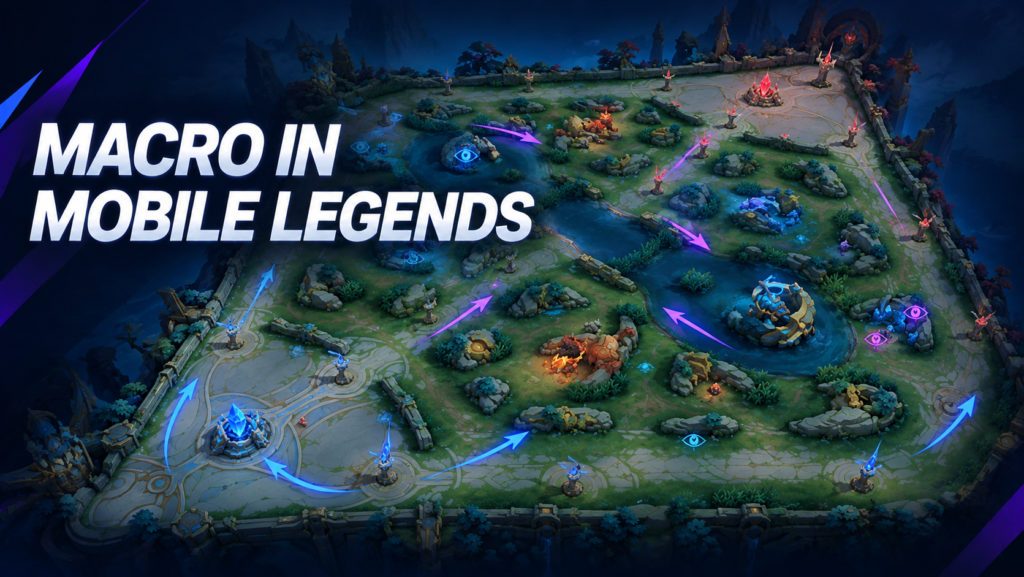
In Mobile Legends: Bang Bang, a hero's mechanical skills are far from the only factor that determines the outcome of a match. Even a strong player can lose if the team distributes resources incorrectly, rotates between lanes at the wrong time, or takes unfavorable team fights. That is why one of the most important elements of the game is macro — understanding the situation on the map and making the right decisions.
Macro covers practically every team action: rotation paths, objective control, lane management, ways of pushing, team fights, and destroying turrets. At the same time, different roles need to pay attention to different things.
For example, the jungler and roamer should constantly monitor the state of their allies' lanes. It is especially important to notice a lane where the minion wave has moved closest to your own turret. This is where an opportunity for a gank may appear. At the same time, during a rotation, you need to use a route that prevents the opponent from spotting your approach too early.
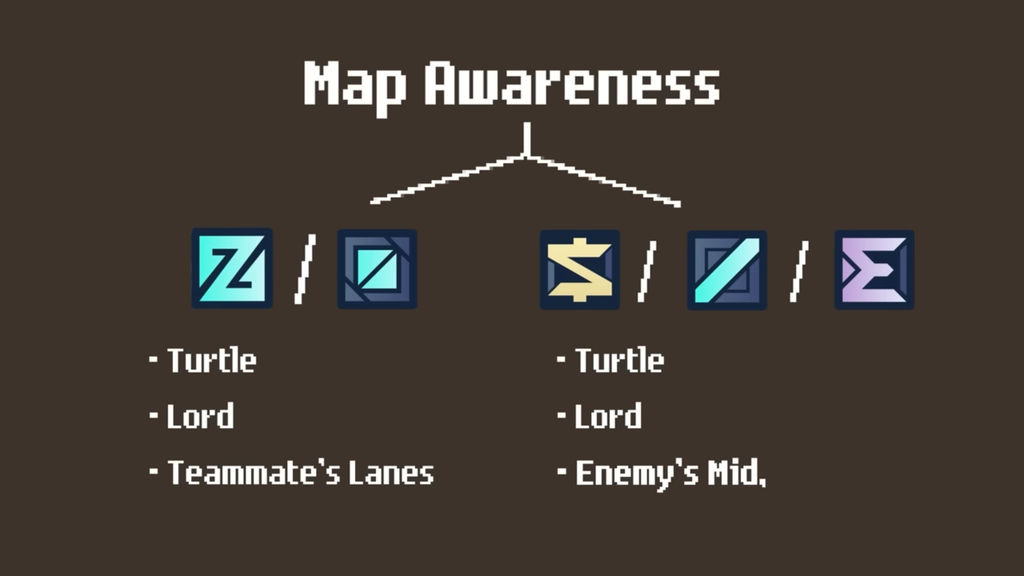
Players in the Gold Lane, Mid Lane, and EXP Lane need to keep track of the positions of the enemy mid laner, roamer, and jungler. If any of them disappears from the map, it is safer to temporarily fall back and continue farming rather than trying to push aggressively and risking death.
This is why professional players can often spend a long time sitting in bushes at the beginning of a match. They are not necessarily looking for a fight — sometimes it is much more important to remain unseen and wait for the right moment.
If an ally is moving toward your lane for a gank, the lane also needs to be prepared. You can freeze the minion wave near your own turret or, on the contrary, quickly push it forward if the team is planning a dive under the enemy turret. It is also important to save crowd-control abilities so they can be used at the exact moment your ally arrives.
At the same time, an unsuccessful gank does not always mean that the jungler or roamer made a mistake. The outcome often depends on how well the laner performed their part of the play.
Strong Side and Weak Side of the Map
To rotate correctly, it is necessary to understand the concepts of strong side and weak side. The map can roughly be divided into two areas: from the Mid Lane toward the Gold Lane and from the Mid Lane toward the EXP Lane.
The side where the jungler, mid laner, and roamer are currently located is considered the strong side. Here, a player can afford to play more aggressively because allies are nearby and ready to provide assistance.
The opposite part of the map is the weak side. Here, players need to act more carefully because it will be more difficult to receive quick assistance from the team.
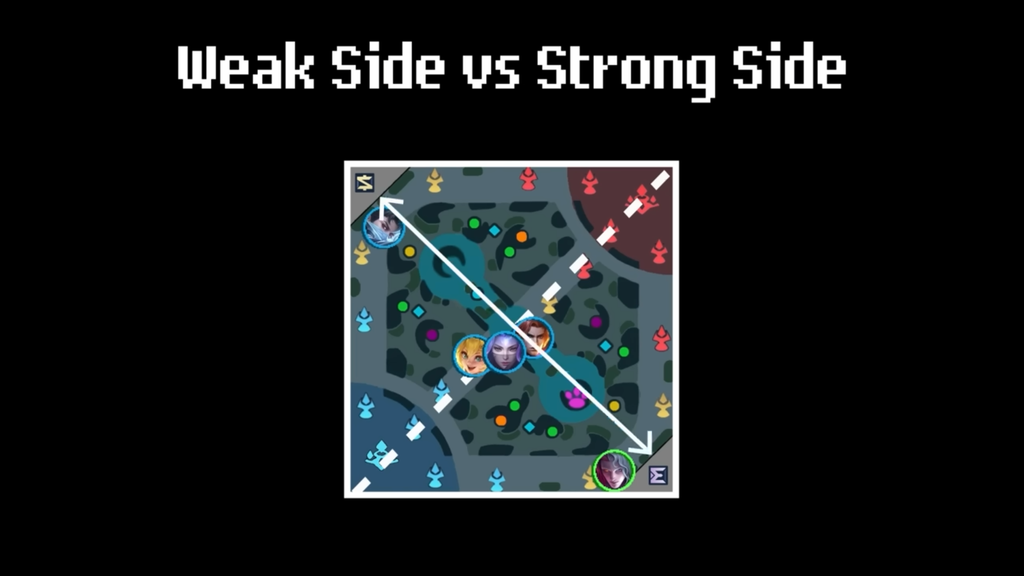
The position of the strong side often determines the direction of the next rotation. There are several basic options. One is helping a losing lane to stabilize the situation and prevent the opponent from gaining an even bigger advantage. However, such a rotation only makes sense if the player on that lane can recover after the levels and resources have been brought closer together.
Another option is helping a lane that is already winning. This allows the team to increase its advantage even further by taking crabs, turret plates, enemy heroes, and other resources. Meanwhile, the losing lane can simply play safely while the other four players create an advantage across the map.
If the team does not know which side to choose for a rotation, one of the simplest reference points can be the Turtle. If the Turtle spawns on the EXP Lane side, the team should help the EXP Laner prepare for the objective fight. If it is located on the other side, the direction of the rotation should change accordingly.
Regardless of the route, the team needs to communicate. For example, information about an enemy's used ultimate or the absence of Flicker on an enemy hero can directly determine whether the team should start an attack.
Which Turrets Are the Most Important?
Not all objectives on the map have the same value. This is especially important when choosing between destroying a mid turret and a side-lane turret.
On the Land of Dawn, there are T1, T2, and T3 turrets. The central T1 and T2 turrets have particular strategic importance because destroying them gives the team significantly more space to move between lanes and around buff areas.
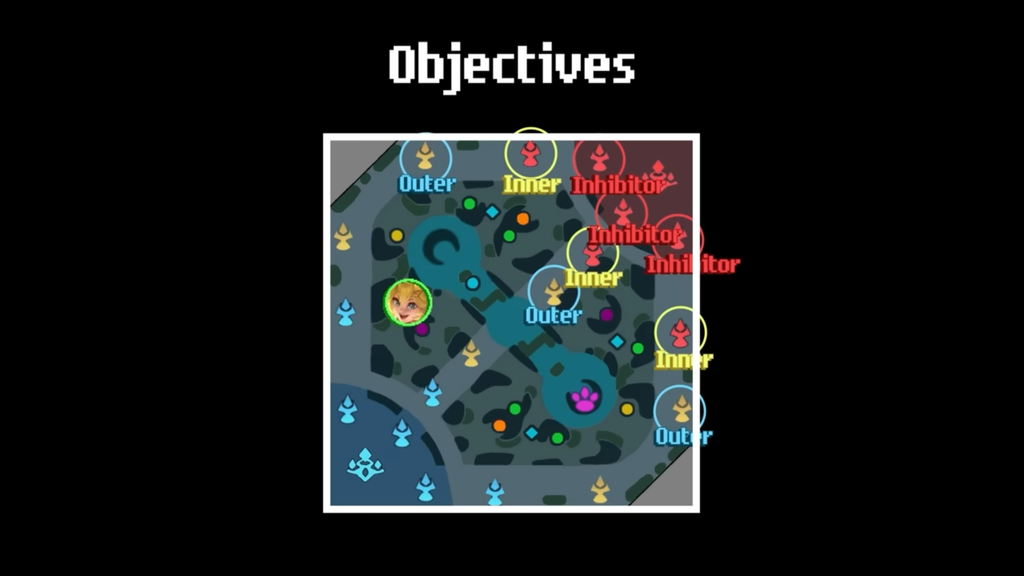
If both central turrets are destroyed, the Mid Laner and Roamer have more difficult conditions for rotating, while the Gold Laner and EXP Laner become more vulnerable. It also becomes harder for the jungler to farm safely, while the enemy gains the opportunity to enter your side of the jungle.
At the same time, the Mid T3 can have less strategic value than it might seem. If Super Minions begin spawning on the Gold or EXP Lane after an inhibitor is destroyed, the enemy has to constantly control that lane. This can create space for your team to prepare an attack on the Lord.
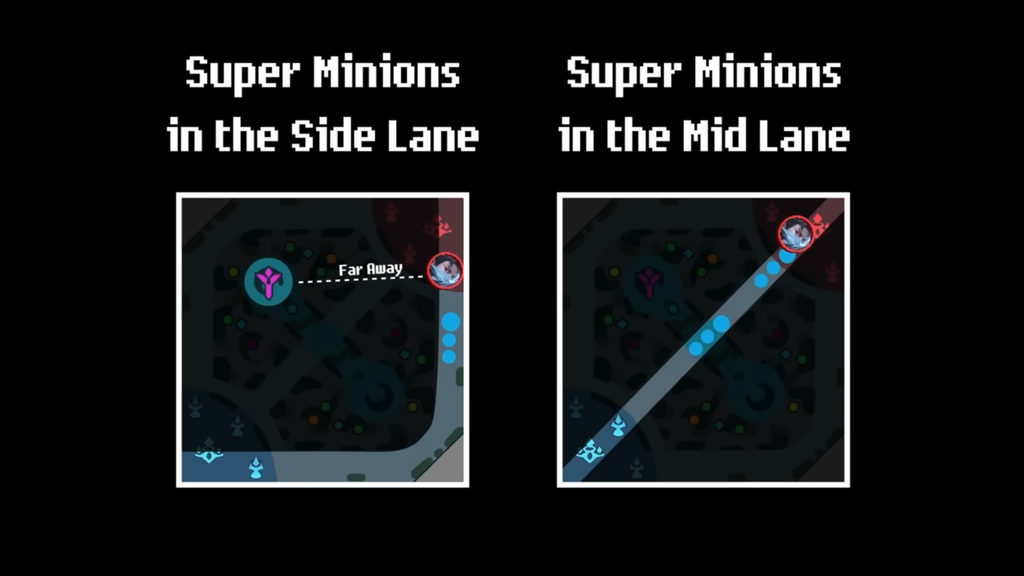
The situation changes if Super Minions appear on the Mid Lane itself. The central lane is shorter, making it easier for the enemy to control the wave and harder for your team to gather enough minions for a further push.
Therefore, the general principle is: for T1 and T2, the Mid Lane is the priority, while for T3, the side lanes are more important.
What to Do When There Are Several Options?
During a game, a team often faces a situation where it can choose between several actions: take turret plates (the protection on T1), destroy a turret, clear a minion wave, attack an enemy hero, or take a crab.
The priority depends on the specific situation. If there is a high chance of securing a guaranteed kill, this may be the most valuable action. Turret plates also have a high priority because they disappear after the fifth minute. Minions and crabs provide gold and experience, while a turret does not always need to be destroyed immediately.
This is especially important on the Mid Lane, where the central turrets have greater strategic value because of the map control they provide.
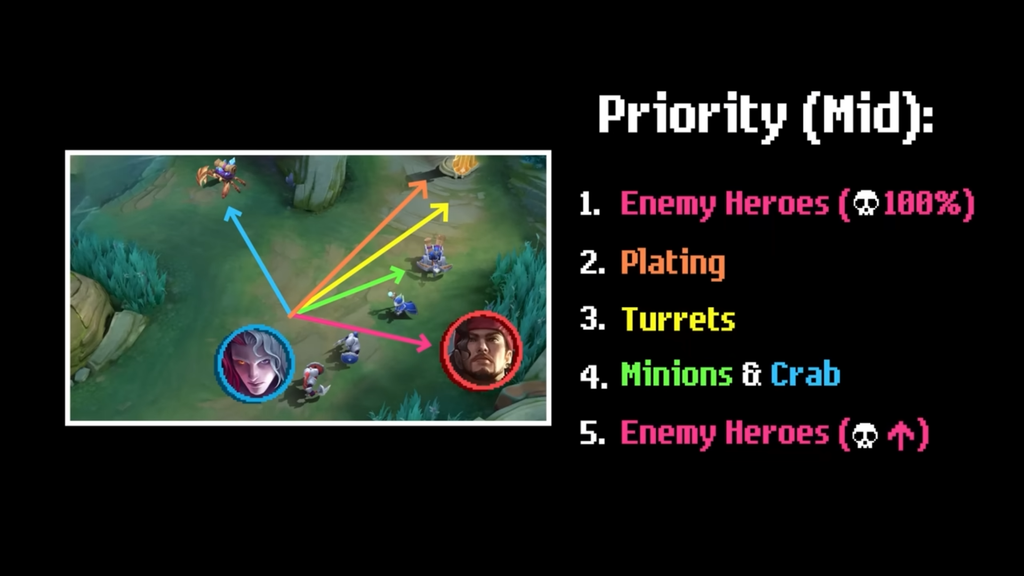
Sometimes destroying a turret can even be less valuable than taking a crab. For example, destroying a turret gives the team a certain amount of gold, but afterward the enemy can gain gold from the next minion wave. If you take the crab instead, the minions may die under the turret without giving the enemy additional gold.
That is why decisions should not be made according to the principle that “the turret is always more important,” but by taking the entire situation on the map into account.
Hard Push and Slow Push
In Mobile Legends, there are different ways to manage minion waves.
Hard Push is the fastest possible push, where the player tries to move the wave forward as quickly as possible.
Slow Push works differently: minions gradually accumulate, after which a large wave slowly moves forward. This approach is particularly useful on a lane that is far away from the main objective, as the team can create pressure without being directly nearby.
It is important to understand that Hard Push and Slow Push are methods of managing a lane, rather than separate ways of directly destroying turrets.
Three Main Team Fight Strategies
Even correct rotations and resource control will not produce results without an understanding of how the team should fight.
The first option is Pick Off. Its goal is to isolate and eliminate a single enemy hero. A common setup is a 3v1 situation, while the other two teammates continue farming or defending the base. This strategy is particularly useful for a team that is behind in resources.
The second option is Grouping, when the entire team gathers for a full 5v5 fight. This approach is especially effective when the team already has an advantage and a high chance of winning a direct confrontation.
Split Push can be used against grouping. In this case, part of the team applies pressure on separate lanes and forces the opponent to split their forces. This strategy is useful for a team that does not want to engage in direct team fights and instead wants to gradually create pressure across the map.
However, Split Push requires heroes that can quickly escape dangerous situations, such as Sun, Ling, Aulus, or other mobile characters.
How to Properly Push Turrets With the Lord
The ultimate goal of all these decisions is to destroy the enemy base. However, even after gaining an advantage, teams often organize their push incorrectly and give the opponent an opportunity to defend.
Before the 18-minute mark, one option is a three-lane push. Its purpose is to create pressure on all three lanes at the same time so that the opponent does not know which one to defend.
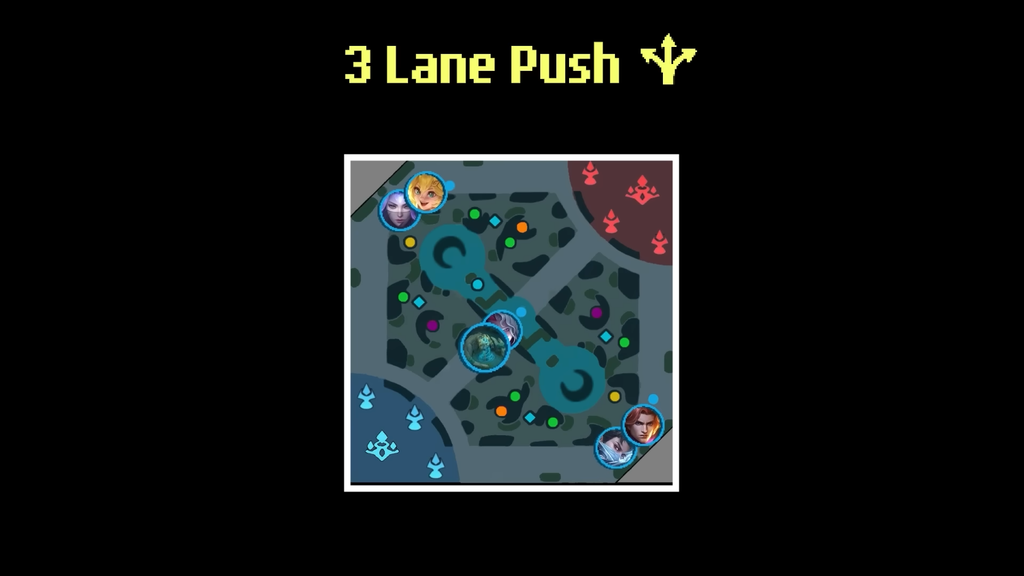
When the Lord appears, the team can use a Hard Push on the Gold Lane and EXP Lane while pushing the Mid Lane more slowly. Once the waves on the side lanes reach the desired position, the team can quickly push the Mid Lane so that all three minion waves approach the enemy base at approximately the same time.
After the Lord evolves, the strategy changes. In this situation, the team can switch to a straight push, with all five players accompanying the Lord. The evolved Lord gains additional damage resistance when allies are nearby, making a coordinated push more effective.
Sometimes the Best Decision Is to Give Up an Objective
Macro is not only about gaining an advantage. It also helps minimize losses.
In professional matches, a team may sometimes deliberately give up the Turtle or another objective if fighting for it would be unfavorable.
For example, consider a match between Team Liquid Philippines and ONIC Indonesia at the Esports World Cup. Liquid decided not to contest the Turtle after one of its players was killed, leaving the team in a 4v5 situation.
Instead of risking a team fight, losing the Turtle, and giving the opponent an opportunity to make a comeback, Liquid gave up the objective and preserved its advantage. As a result, the team was able to close out the match with a victory.
The same principle applies to regular players. If a team suddenly starts a fight without its jungler ready, or someone tries to steal the Turtle alone in an unfavorable situation, sometimes the correct decision is not to join the risk.
In Mobile Legends: Bang Bang, macro is not only about constantly looking for opportunities to attack. A player needs to understand when to pressure the opponent, when to help an ally, which objective has greater value, how to manage minion waves, and, most importantly, when it is better to avoid a fight.
It is the combination of these decisions that allows a team to gain an advantage even without constantly winning mechanical duels.
As a reminder, Leaks Reveal Lapu-Lapu "Aurora Gaming PH" M7 Champion Skin in Mobile Legends: Bang Bang.