Ahead of The International 2026, which will take place in Shanghai, Dota 2 is facing a serious conceptual challenge. Despite high expectations from the Chinese audience and the success of the previous tournament in Hamburg (1.77 million peak viewers), the game is gradually transforming into a purely spectator discipline. Active player statistics, revenues, and interest in esports events outside of TI are showing a downward trend.
Although developers report a certain "recovery" of the game—an increase in average monthly players from the 420,000-440,000 range in 2023 to over 600,000 in early 2026—these numbers are misleading. Record spikes in online concurrents were caused exclusively by temporary events: last year's TI tournament (961,000) and a crossover with the game Monster Hunter in November 2025 (910,000). As soon as the events conclude, the audience plummets. For comparison, in 2016–2017, monthly online players consistently exceeded the one million mark.
The main reason for the outflow of active players is the changing demographics of the community and the specifics of Dota 2 itself. The toxicity of the community and the length of matches (from 40 to 90 minutes) make the game too demanding for an older audience with limited free time. As a result, an entire segment of fans has emerged who continue to follow patches, support the esports scene, and watch matches, but haven't launched the game client in months.
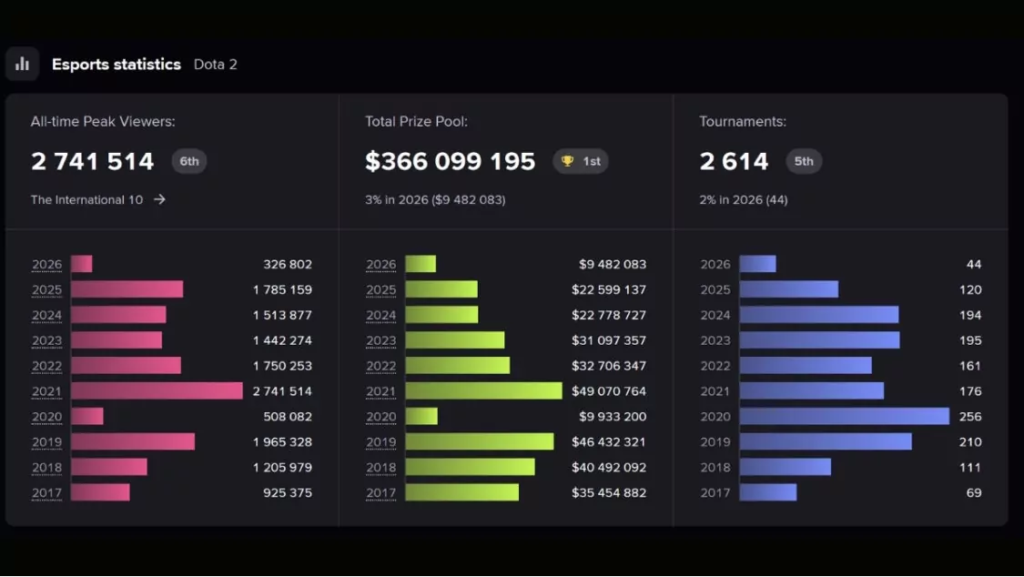
The situation has been significantly worsened by the abandonment of the traditional Battle Pass, which previously created hype several months before the tournament and engaged users in regular play. The current Compendium does not generate a similar momentum. The base prize pool of $1.6 million no longer generates media buzz outside the fan bubble, whereas previously record-breaking amounts attracted the attention of a mass audience.
The lack of global interest directly impacts viewership. The peak audience of the recent EWC 2026 (326,802 viewers) dropped by nearly 24% compared to 2025. Dota 2 was outperformed in popularity by League of Legends, Free Fire, and even the women's Mobile Legends bracket. Statistics for The International itself also indicate a decline: while TI10 (2021) gathered 2.74 million viewers, last year's tournament drew only 1.78 million. The game is rapidly losing "casual" viewers, who were previously drawn in by the scale of the event.
Experts note that the upcoming The International in Shanghai has the potential to be a spectacular event, especially if local teams, such as Vici Gaming, show strong results. However, a successful tournament cannot solve a systemic problem on its own: without an infrastructure to hold players' attention year-round (like the Battle Pass used to), TI is forced to bear the entire burden of maintaining interest in Dota 2 single-handedly.
As a reminder, The Ghost That Changed the Industry: The Full Story of P.T. / Silent Hills in the Context of the Great Franchise


