In 2026, a female esports player’s career is determined not so much by talent itself as by the kind of economic “pipeline” connected to the discipline: whether there are stable payments from a publisher/league, or whether everything relies on one-off prize pools and short-lived media hype. This contrast is easy to see: Riot’s FPS ecosystem is capable of generating systematic cash flows for teams (and therefore contracts), while women’s CS2 in 2025–2026 is openly described as “unviable” even by stakeholders themselves. (valorantesports.com)
Below is an “analysis of the profession” as a P&L (revenues/expenses), as contract architecture, and as an explanation of why in some disciplines this is a real career, while in others it is almost tournament-based volunteer work.
According to Esports Charts, 2,941 female esports players are registered in their database (though not all are active). (escharts.com) This is a good indicator of the market’s “upper layer”: talent and willingness to compete exist, but professional positions appear only where there is guaranteed cash flow.
In 2025, women’s esports simultaneously showed two opposite trends:

For the profession, this means fewer chances to earn regularly, but more chances to “hit big” at a single major tournament. In other words, the profession becomes even riskier: income volatility increases.
A professional career in women’s esports works only when a player and a team have not one, but at least 3–5 income streams.
This is the basic “salary” component, but it exists only where a team can plan its budget for 6–12+ months. The best illustration is the VCT model: Riot publicly stated that in 2024 VCT “shared $78.4M with teams,” of which $44.3M came from digital goods. (valorantesports.com) This is not “women’s money” directly, but it shows a system where the league generates payments to teams—exactly what makes long-term contracts possible.
In the women’s segment, prize money is concentrated in a few major events/regions. Esports Charts notes that MENA contributed 20% of the $3.3M women’s prize pool in 2025, largely due to EWC and Saudi events. (escharts.com) Geography is therefore not just “interesting” here—it is decisive.
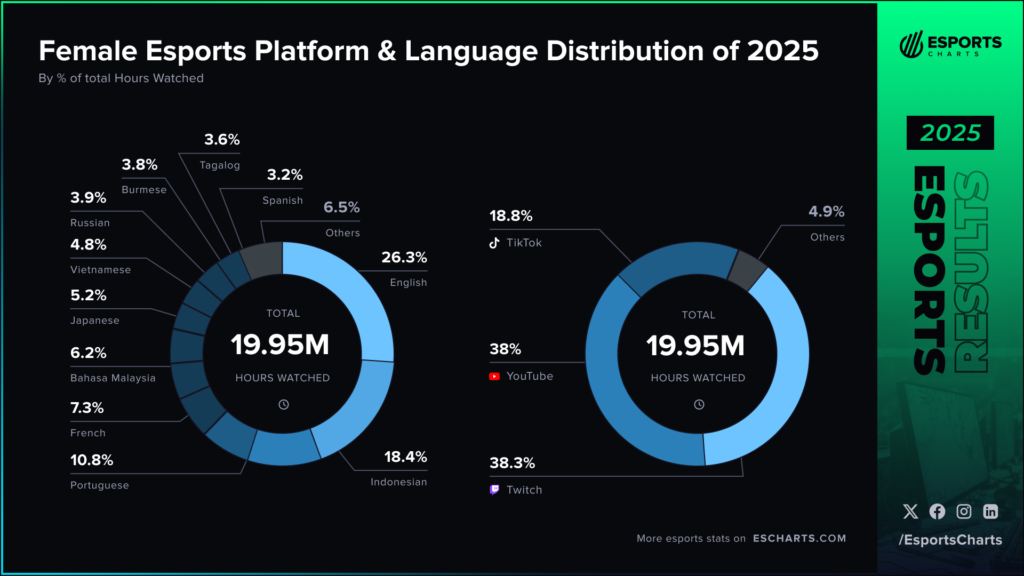
In 2025, Esports Charts recorded a shift: the share of TikTok and YouTube in women’s esports increased, and now Twitch and YouTube are roughly equal in viewership share. (escharts.com) This means that for many players (especially in mobile disciplines), content is not a “hobby” but a financial necessity, because that is where attention, partnerships, and personal brands are monetized.
These appear where content is measurable and consistent. A telling fact: Esports Charts’ 2025 report mentions that VGCC 2025 (Valorant GC Championship) generated $1.88M in Media Value—meaning that even in a weaker year in terms of viewership, the tournament delivered measurable commercial value. (escharts.com)
This works more often in Asia and in multisport formats, where women’s disciplines receive “representative” status.
Women’s CS2 is the clearest example of how even strong institutional support does not guarantee sustainability. ESL officially announced that it is suspending ESL Impact after Season 8 because “the current economic model is simply not sustainable.” (pro.eslgaming.com) Even in 2025, ESL/EFG described $1M in total financial support (including a $300k prize pool and $700k in Seasonal Club Incentives), but this proved insufficient for a long-term model. (ESL FACEIT Group)
At the same time, NAVI expressed the same view twice regarding the women’s CS segment: the business model “appears unviable and does not allow long-term planning.” (navi.gg)
For players, this means something very practical: shorter contracts, lower salaries, and a real risk of “losing a season.”
Valorant’s strength lies not in “game popularity” but in the publisher’s public support for the ecosystem’s economy and in making team payments part of the structure (digital goods and other mechanisms). (valorantesports.com) This does not solve all problems of the women’s segment, but it radically reduces the main professional risk: the risk of the calendar disappearing.
Women’s MLBB is a strong example of a “peak economy that can be converted.” MWI 2025 had a $500,000 prize pool, 16 teams, qualifiers from 57 regions, and a $150,000 champion’s prize. (Moonton)
However, the nature of the mobile market pushes players toward the creator economy: YouTube and TikTok are structurally more important, and “salary-based careers” often exist as a mix of contract + prize money + content.
In women’s esports, four contract models are most common—and they should be understood as different levels of stability.
Works when a club has predictable income (league/publisher/major sponsors). This is the basic path to a “profession.”
The most realistic model for women’s rosters in 2026: less guaranteed income, but bonuses for results, content, and media plan execution.
Typical for ecosystems with unstable calendars (women’s CS2 after the ESL Impact pause is a likely case). (pro.eslgaming.com)
Works where platforms provide monetization and brands can “buy” attention.
In women’s esports, costs are often underestimated, because it seems that “the main thing is prize money.” In reality, the key question is: how much stable preparation costs, and who pays for it.
The market already offers concrete commercial packages that define the lower price threshold. For example, some services declare starting prices of “from €1,500/week” for bootcamp packages. (Goexanimo)
There are also transparent offers such as €995 for a “practice + accommodation” package (format “5+1” for 6 people) from some providers. (enat.gg)
The point is not to calculate every euro, but to conclude that for most women’s teams, a single bootcamp can easily consume a significant share of annual prize earnings if there is no stable salary model or sponsor.
Additional systemic costs include:
In 2026, the profession becomes real where three conditions coincide:
Where the calendar and economics depend on “a single support line,” the profession quickly degrades into short contracts and tournament volatility—as shown by the ESL Impact case and clubs’ public statements about the model’s “unviability.” (pro.eslgaming.com)


