On August 9, 1996, Death Crimson was released in Japan on the Sega Saturn — a little-known rail shooter that subsequently earned a reputation as one of the console's most infamous games. Today, it is remembered not only for its technical issues, but also for the amazing story of a failure transforming into a cult game.
In the mid-1990s, the light-gun shooter genre was experiencing a real boom. Arcade cabinets allowed players to literally hold weapons in their hands and shoot at enemies on the screen, and the success of such projects was gradually transferred to home consoles.
Riding this wave, the Japanese studio Ecole Software created Death Crimson. The game was designed for a single player and used a rail shooter format: the camera moved along a predetermined route, and the user's task was to destroy enemies in time.
The release took place on August 9, 1996, in Japan. This date is confirmed by MobyGames, GameFAQs, and the Sega Saturn database Satakore.
The main protagonist was Kosuke Echizen, known by the code name Combat Echizen. According to the plot, he is a doctor and a former military officer who spent ten years researching KOT Syndrome — a mysterious disease that spread across Europe and turned people into monsters.
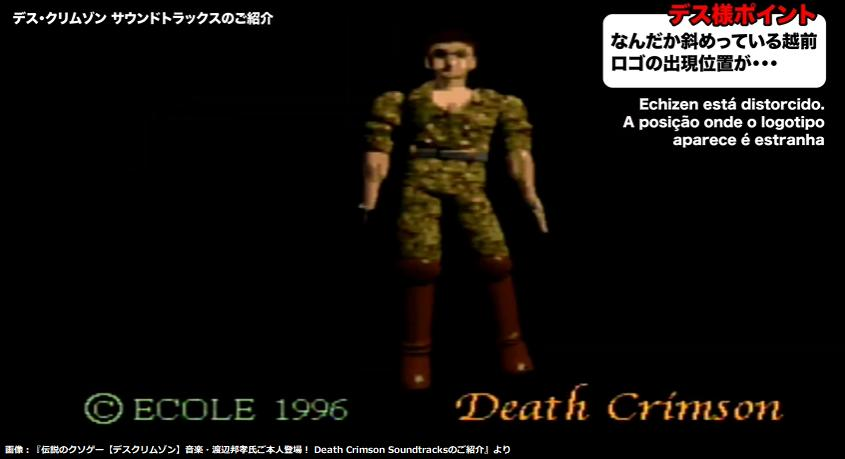
The cause of all this was linked to the mysterious weapon Death Crimson, which Echizen found during his military service.
On paper, Death Crimson made complete sense for its time. The Sega Saturn supported a light gun, and the popularity of arcade shooters created a good opportunity for Ecole.
However, after release, it became clear that the game had serious issues.
Today, Death Crimson is most often criticized for its low graphics quality, clunky controls, hit detection issues, weird camera, and overall technical flaws. GOG describes it as an example of Japanese kusoge — a term used to denote intentionally or unintentionally terrible yet uniquely charming games.
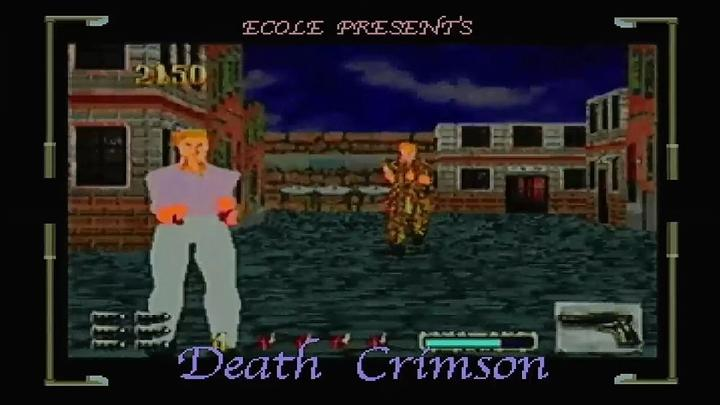
GameFAQs even includes Death Crimson in its list of the most famous kusoge, calling it an extremely unsuccessful light-gun shooter.
The visual style itself looked particularly strange. By the time of its release, the Saturn was already receiving much more impressive 3D games, whereas Death Crimson displayed clumsy models, weird animation, and rather crude visuals. And that exact factor became one of the reasons for its future fame.
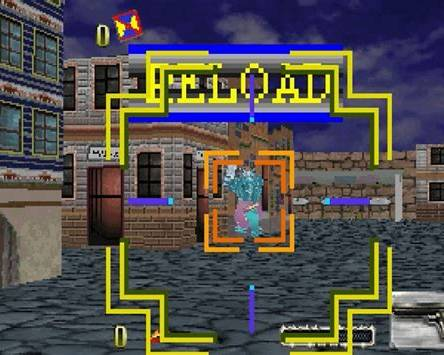
Interestingly, Death Crimson did not disappear after its failure. On the contrary — over the years, a reputation formed around it as a game so bad that it became interesting in its own right. In the Japanese gaming community, Death Crimson came to be viewed as a benchmark for kusoge.
Moreover, the game possessed all the necessary ingredients for cult status.
An unusual main protagonist, a strange plot, peculiar voice acting, bizarre enemies, problematic graphics, and an overall unique atmosphere created a combination that was hard to forget.
A separate chapter of the legend became the voice of Combat Echizen. Due to the lack of proper information about the actor, he could not be properly identified for a long time. Later, it became known that the character was voiced by the actor Seijirou, who later also worked on other well-known Japanese games.
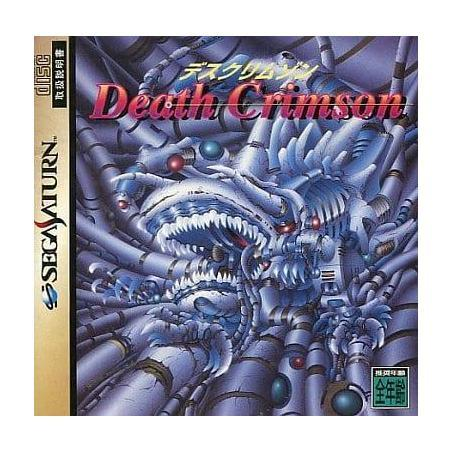
Today, the game's physical box art also attracts special attention.
The cover of Death Crimson depicts a huge biomechanical creature with metal pipes, teeth, and tentacles. It is significantly more impressive than the game itself and effectively became one of the most recognizable elements of the project.
But the true highlight was its support for the light gun. It could be played with the corresponding Sega Saturn controller, which at least partially matched the arcade nature of the project. That is why today Death Crimson is also interesting as part of the history of light-gun games in the mid-1990s.
The paradox of Death Crimson is that most games that earned a similar reputation were simply forgotten over time.
With it, the opposite happened. People began discussing it precisely because it was so strange. Reviews, videos, memes, and collectors emerged, specifically hunting down the original Sega Saturn version.
Even decades later, the game continues to receive attention. In 2024, the Japanese gaming outlet 4Gamer reported on the publication of official videos featuring the intro and promotional materials for Death Crimson.
And in 2026, a new fan patch emerged for the game featuring quality-of-life improvements for modern ways of playing light-gun games on the Saturn. This shows that a project that might once have seemed like a forgotten failure still maintains an active retro community.
Despite the failure of the first game, Ecole Software did not abandon the series. On the contrary, the company continued the story.
On November 25, 1999, Death Crimson 2: Meranito no Saidan — a direct sequel to the original — was released in Japan on the Sega Dreamcast. GameFAQs confirms this date and lists Ecole as both the developer and publisher.
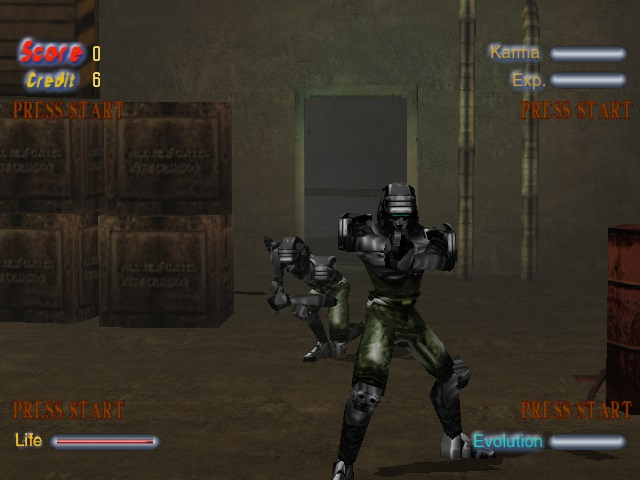
This time, Ecole attempted to create a significantly larger-scale project. Death Crimson 2 retained the core of a light-gun shooter but gained a story mode with branching paths dependent on player choices, as well as support for up to four players.
The first Death Crimson virtually lacked a full story mode, so the sequel placed a much greater emphasis on narrative and characters. In 2024, a new English fan translation was even released for Death Crimson 2, allowing players to better immerse themselves in the series' lore.
In 2000, Ecole released the arcade title Death Crimson OX running on Sega NAOMI hardware. It was later ported to the Dreamcast and PlayStation 2. This was the third and final installment in the series.
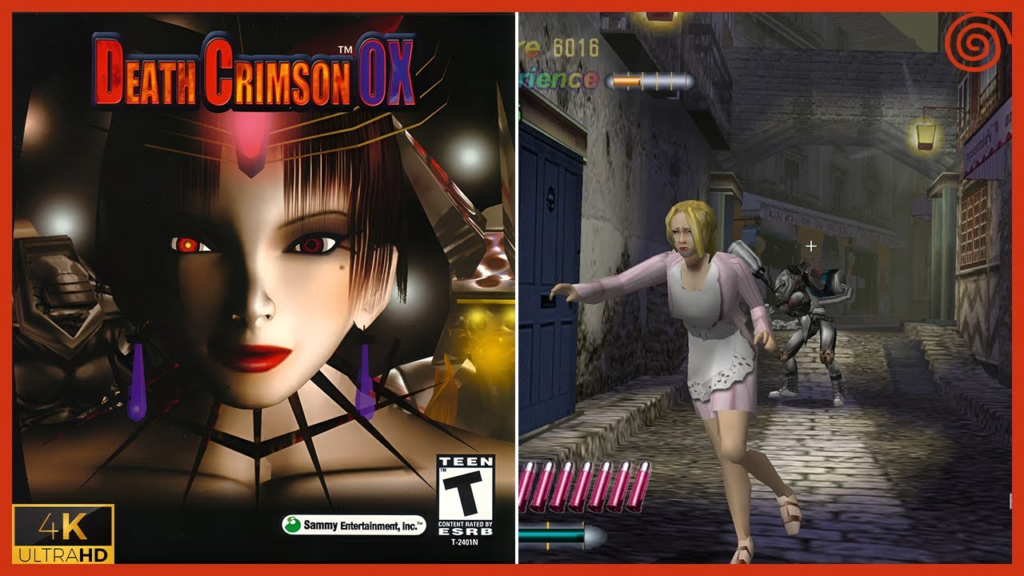
Death Crimson OX became particularly important for the franchise, as it was the only game in the series officially released outside of Japan. In Europe, it was released under the title Guncom 2. The PlayStation 2 version titled Guncom 2 arrived in Europe in December 2004.
Interestingly, it was Death Crimson OX that adopted a much more traditional look for the genre, coming closer to popular light-gun shooters like The House of the Dead.
Thus, what began in 1996 as Ecole's failed experiment on the Sega Saturn ultimately turned into a full-fledged three-game series.
Death Crimson does not hold the status of a major hit that changed the industry. It did not become a competitor to Virtua Cop or any other major light-gun shooter series.
Its historical value lies somewhere else entirely. Death Crimson became an example of how a failed game can receive a second life due to its own uniqueness. Its technical issues, strange design, and unforgettable characters transformed the game into a kind of artifact of the Sega Saturn era.
In 1996, Ecole wanted to make just another shooter with light-gun support. 30 years later, Death Crimson is remembered for something else entirely.
It is remembered as that very game that was so bad it became legendary.
And perhaps that is the best proof that in the history of video games, the best don't always win.
As a reminder, 20 Years of Dwarf Fortress: How Two Brothers' Experiment Changed the Genre and Made It to Steam.


