On September 6, 2011, Warhammer 40,000: Space Marine was released in North America — a game by Canadian studio Relic Entertainment and publisher THQ that became one of the most notable experiments in video games under the Warhammer 40,000 license. Unlike Dawn of War, with which Relic was already firmly associated, this time the developers abandoned real-time strategy and placed their bet on spectacular third-person action. The game combined shooting, melee combat, and massive battles, allowing players, for the first time in Relic's history, to step directly inside the Warhammer 40,000 war rather than commanding it from above.
Prior to creating Space Marine, Relic was primarily known for its strategy games. It was the studio behind Dawn of War and Company of Heroes, so transitioning to a full-fledged third-person action game was a major departure from its established formula. The team was effectively returning to console development for the first time since 2006's The Outfit, and Space Marine represented Relic's attempt to prove that its expertise could work well outside the RTS genre. Notably, after release, producer Andy Lang called the game the studio's best console work, while simultaneously acknowledging that the team lacked the time to polish certain elements to the desired level.
The developers' core idea was fairly simple — to make players truly feel like a Space Marine. Instead of commanding a squad, players took control of Captain Titus, an elite warrior of the Ultramarines chapter, who finds himself in the epicenter of a massive Ork invasion. Relic wanted to convey not just the visual look of Warhammer 40,000, but the very feeling of a Space Marine's power: heavy armor, devastating weaponry, colossal enemies, and a constant sense that a full-scale war was raging around them. That is why the developers refrained from creating a standard cover shooter where the protagonist mostly hides behind obstacles, building the combat system instead around seamless transitions between ranged shooting and melee attacks.
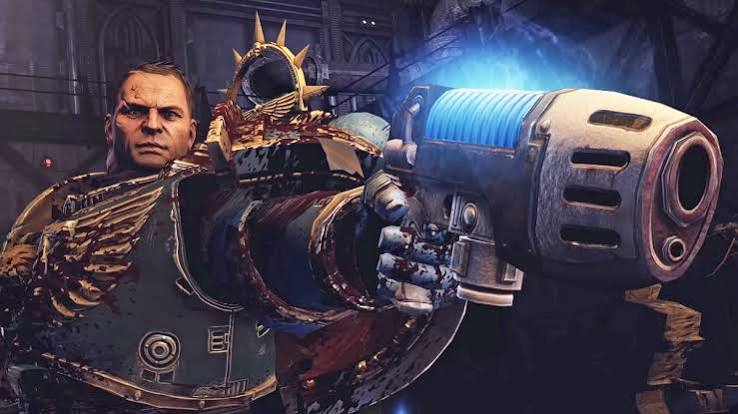
At the time, most well-known Warhammer 40,000 games were strategies, so Space Marine had to present the familiar universe from an entirely different perspective. Developers described the concept as a hybrid of a third-person shooter and an action-brawler, where firearms and melee combat had to work in tandem. Players could gun down Orks with a bolter, and seconds later leap into the middle of a crowd to switch to a chainsword, power axe, or other melee weapons. This shift in pacing became one of the game's defining features, allowing Relic to create the feeling that Titus was not merely a soldier with a gun, but a true machine of destruction.
The game's events unfold on the Forge World of Graia, which becomes the target of a massive Ork invasion. Captain Titus, along with a small squad of Ultramarines, arrives on the planet to assist Imperial forces in halting the enemy. However, the situation quickly spirals out of control as the forces of Chaos intervene in the conflict. The story did not attempt to be a complex political drama — its primary goal was to create a sweeping military adventure that constantly propelled the player from one battle to the next. Massive engagements constantly rage around Titus, huge war machines are visible on the horizon, and the hero finds himself at the center of a three-way war between the Imperium, Orks, and Chaos.
One of Space Marine's most intriguing features was its health regeneration system. Instead of traditional passive regeneration, Titus recovered health by executing enemies, often making it more advantageous for the player to dive straight into a crowd rather than retreat. This created an unusual rhythm for a shooter: upon taking heavy damage, you wouldn't necessarily look for cover, but rather risk getting up close and personal with the enemy. This mechanic perfectly fit the image of a Space Marine, who should not fear overwhelming odds and is capable of literally tearing through dozens of foes. The game also featured a wide arsenal of weapons, ranging from the bolter and bolt pistol to the plasma gun, melta gun, and sniper rifle.
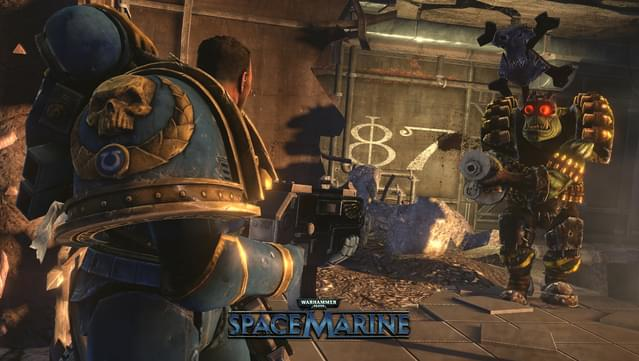
A huge advantage for Relic was that the studio already possessed a deep understanding of how Warhammer 40,000 should look and feel. Having created Dawn of War and its sequels prior to Space Marine, the developers didn't need to learn the universe's atmosphere from scratch. Massive industrial complexes, orbital ships, Ultramarines, Orks, Chaos, bolters, chainswords, and giant war engines seamlessly established the authentic 40K feel. This was precisely why fans held the game in high regard: even if mechanics were not always flawless, Space Marine captured the fantasy of being one of the Imperium's greatest warriors extraordinarily well. Critics also noted that Relic successfully translated its attention to detail from Dawn of War into an entirely different genre.
However, Space Marine was not without its flaws. Following release, critics most frequently pointed out the campaign's linear structure, repetitive encounters, relatively limited mechanic pool, and short length. The game worked brilliantly as a pure action title, but made little attempt to offer a deep RPG system or complex mission design. Even Relic's producer admitted post-launch that the team lacked time to bring certain elements up to the desired standard, agreeing that some criticism regarding repetition was well-founded.
Despite this, reviews remained mostly positive. On Metacritic, various versions of Space Marine scored in the average to generally favorable range, with an aggregate score on one primary platform standing at 76/100 from critics and around 7.9/10 from users. GameSpot awarded the game a 7/10, praising its spectacular battles and blend of shooting and melee combat, while criticizing its limited variety. Game Informer rated the game an 8/10, calling it the second-best Warhammer 40,000 adaptation after Dawn of War and specifically highlighting its combat system.
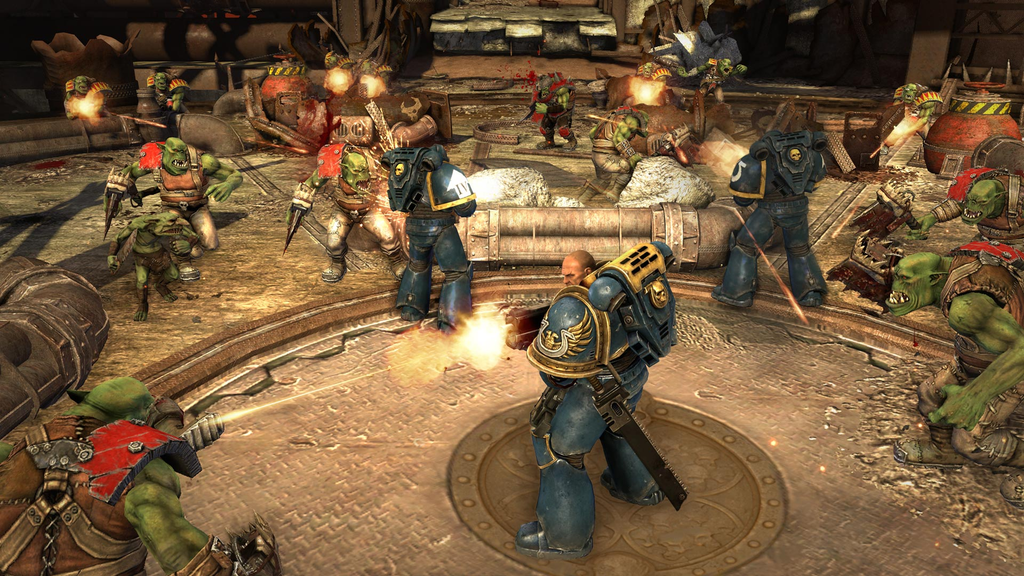
Multiplayer formed a distinct component of the package. Relic included team-based modes, customization for both Space Marines and Chaos Space Marines, and a progression system that unlocked new gear to craft a personalized warrior. Post-launch, the studio supported the game with additional content, most notably the Exterminatus mode, where players could team up to fend off waves of enemies. This was significant as it allowed the combat system to shine beyond the main campaign, giving the game extended longevity after the story was finished.
At launch, Space Marine did not become a new genre benchmark or achieve sky-high review scores. However, its significance for Warhammer 40,000 proved far greater than it seemed in 2011. The game demonstrated that this universe could thrive not only as a strategy game where players command an army, but as a direct action title where they become part of the battle themselves. Relic effectively showcased a different way to experience 40K: instead of looking down at Space Marines from above and issuing orders, players put on the armor themselves, grabbed a bolter, and headed into battle.
Years later, this concept received a follow-up. In 2024, Warhammer 40,000: Space Marine 2 released, bringing back Captain Titus with a focus on modern graphics, massive enemy swarms, and co-op gameplay. The success of the sequel renewed interest in the original game, prompting many players to revisit Titus's origin story. And while the 2011 Space Marine appears simpler and smaller in scale today, its core idea proved remarkably durable — giving players the opportunity not to command the Warhammer 40,000 war, but to stand at its very center.
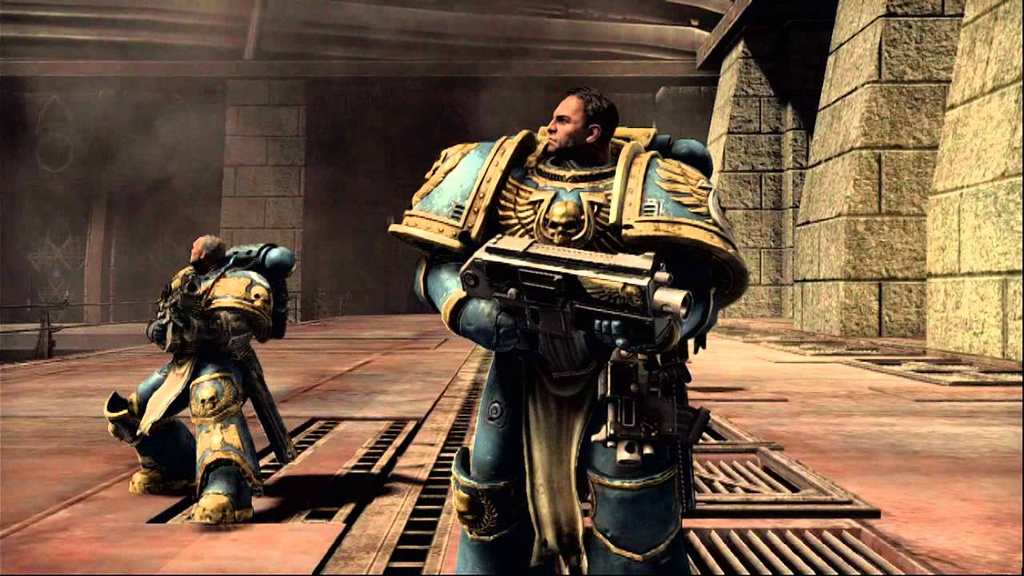
Warhammer 40,000: Space Marine was not a perfect game. It can be criticized for linearity, repetition, and a lack of depth in certain mechanics, and its review scores never placed it alongside undisputed masterpieces of the genre. But it fulfilled its main task brilliantly — letting the player feel like a Space Marine. Not a commander looking down at the battlefield, not a strategist or bystander, but a massive machine of destruction tearing through crowds of Orks with a bolter and a chainsword.
That is why, years later, Space Marine remains one of the most notable Warhammer 40,000 games of its generation. It marked an important transition from the traditional strategy format of Dawn of War to a full-fledged action game, demonstrating that the Games Workshop universe can function equally well as a strategy, shooter, or large-scale action game. Captain Titus's return in Space Marine 2 only served to confirm that the foundation laid by Relic in 2011 was strong enough to return to more than a decade later.
On September 6, 2011, Warhammer 40,000: Space Marine opened a new chapter for Warhammer — one where, instead of commanding an army, the player became its most dangerous weapon.
As a reminder, September 5, 2008 — S.T.A.L.K.E.R.: Clear Sky released in Europe: creation history, new Zone, and player reaction.


