On November 13, 2007, Assassin’s Creed was released in North America on PlayStation 3 and Xbox 360 — the first game in the eponymous series from Ubisoft Montreal. The project became one of the most important new franchises of its generation and marked the beginning of a series that would eventually span dozens of games, different historical eras, and millions of players.
At the time of its release, Assassin’s Creed attracted attention not only because of its scale, but also because of its approach to game design. Ubisoft sought to combine an open world, parkour, stealth, a historical setting, and cinematic presentation. As a result, the game offered an unusual format for its time, where cities were not just decorations but full-fledged spaces for exploration and completing missions.
The idea for Assassin’s Creed began with another Ubisoft project — Prince of Persia: The Sands of Time. After completing work on the game, the Ubisoft Montreal team was tasked with creating a new installment in the series that would continue its success.
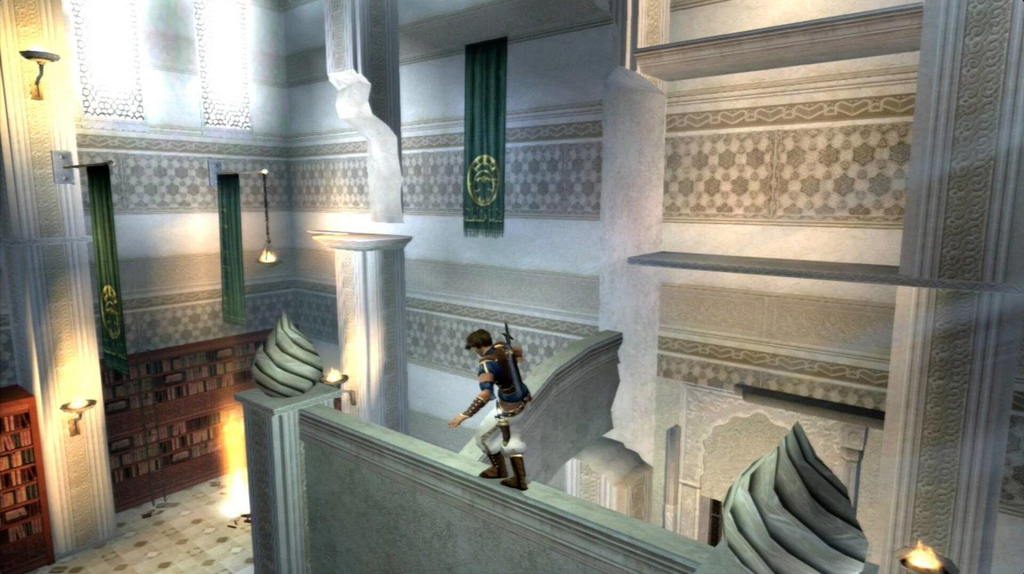
However, the concept gradually changed. The developers began working on a game centered not on the prince himself, but on his guardian — a member of a secret order of assassins. This idea eventually evolved into a separate franchise.
Development lasted about four years. During this time, the team significantly expanded the original concept, while Ubisoft turned Assassin’s Creed into one of its major projects. By the time of release, a large team was working on the game, and the project itself had become extremely ambitious for the new generation of consoles.
The events of Assassin’s Creed take place in 1191, during the Third Crusade. The player finds themselves in the Holy Land and visits three major cities — Jerusalem, Damascus, and Acre. There is also a large territory of the Kingdom between them that can be explored.
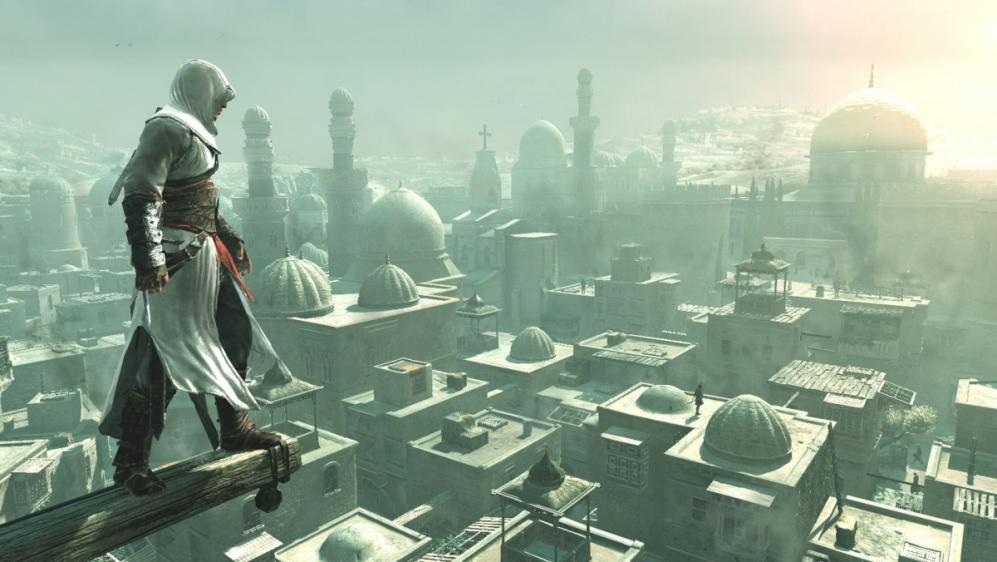
The main character of the historical part is Altaïr Ibn-La’Ahad — an Assassin who, after failing to complete a mission, loses his status and must gradually regain it. To do so, he is given the task of eliminating a number of influential people connected to the conflict in the Holy Land.
The game placed a strong emphasis on its historical surroundings. Ubisoft attempted to create cities that felt alive: streets were populated by residents, soldiers, merchants, and other characters, while the architecture and appearance of the locations were an important part of the experience.
One of Assassin’s Creed’s main features was its movement system. Altaïr could run across rooftops, jump between buildings, climb towers, and use the verticality of cities to move around.
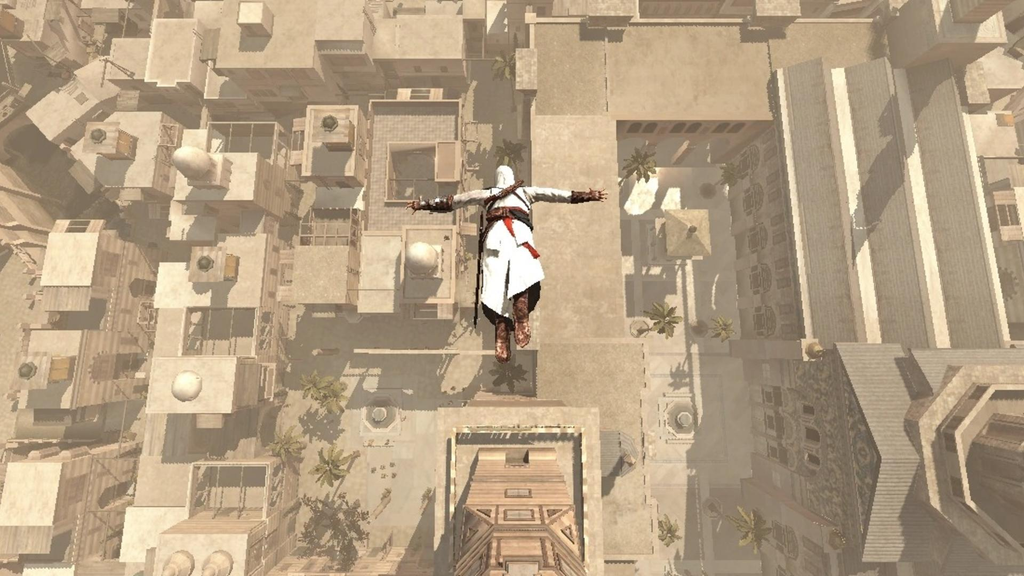
For 2007, this was unusual. Ubisoft effectively made vertical design one of the key elements of its open world. The player could view the city not only from street level, but also move above it, using buildings and other structures.
An important mechanic was also blending into crowds. Altaïr could hide among people, use groups of monks, benches, and other elements of the environment to remain unnoticed. This complemented the stealth mechanics and distinguished the game from conventional action titles.
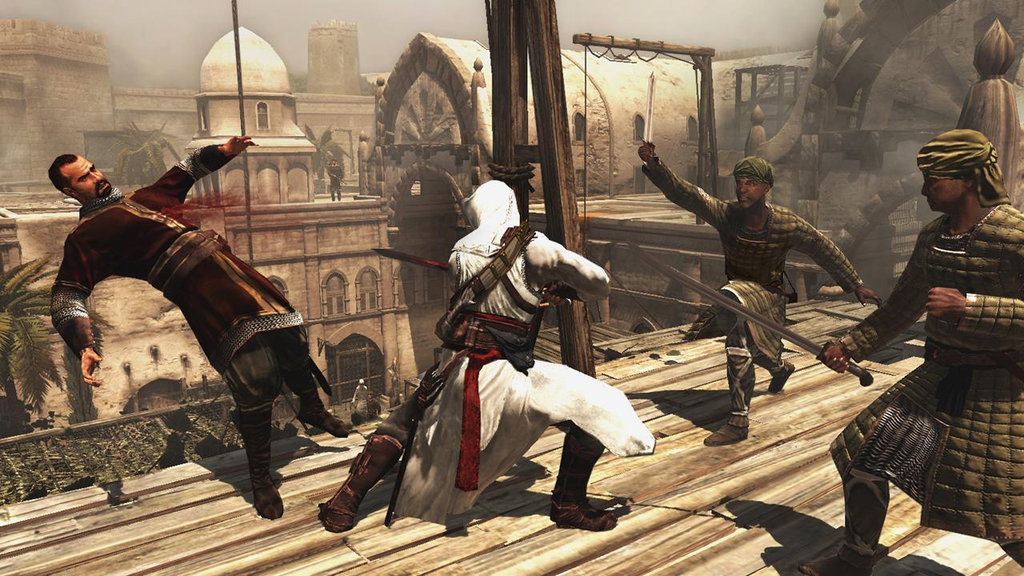
The Assassin’s main weapon was the Hidden Blade, which allowed targets to be eliminated discreetly. The combat system also included swords and other medieval weapons, although performing missions without being detected was a central part of the concept.
Assassin’s Creed was not limited to its medieval setting. Alongside Altaïr’s story, the player learned about Desmond Miles, who lives in the 21st century.

Desmond finds himself in the company of Abstergo Industries, where he is forced to use a device called the Animus. The machine allows access to the genetic memories of ancestors, meaning the player effectively experiences Altaïr’s story through Desmond.
This concept became one of the franchise’s main narrative elements. Thanks to it, Ubisoft could tell stories set in different historical periods while connecting them through a shared modern-day storyline.
Before its release, Assassin’s Creed was one of the most anticipated new games of 2007. Ubisoft actively promoted the project, while the concept itself attracted attention thanks to its beautiful graphics, large cities, and unusual movement system.
After release, critics generally responded positively to the game. GameSpot gave Assassin’s Creed a 9/10, praising its large and detailed world, smooth controls, atmosphere, and story. At the same time, critics pointed out the repetitive nature of the missions and the limited variety of objectives.
On Metacritic, the game received 81 out of 100 based on critical reviews. Thus, Assassin’s Creed was not a flawless project, but it was regarded as a very strong start for a new franchise.
Repetition became one of the main criticisms of the game. Its core structure gradually became predictable: the player explored the city, gathered information about a target, completed preparatory tasks, and moved on to the assassination itself. At the same time, the open world, parkour, and atmosphere allowed players to explore the cities on their own and experiment with different approaches.
Despite the criticism, the game’s commercial performance was very strong. Within its first four weeks, Assassin’s Creed had sold more than 2.5 million copies worldwide, exceeding Ubisoft’s expectations. The company raised its sales forecast for the fiscal year from approximately three million to five million copies.
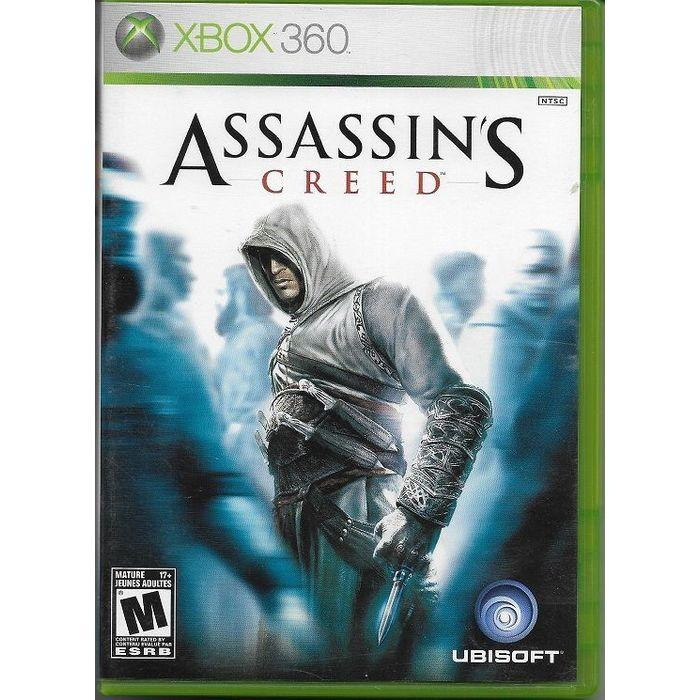
By March 2008, sales had reached 6 million copies, and Ubisoft later reported eight million copies sold for the first Assassin’s Creed.
The success was important not only for the game itself. Ubisoft had gained a new major intellectual property that could be developed for many years. After the first installment, it became clear that Assassin’s Creed could become one of the company’s main franchises.
Following the success of the first game, Ubisoft began actively expanding the Assassin’s Creed universe. In 2009, Assassin’s Creed II was released, moving the setting to Renaissance Italy and introducing a new protagonist — Ezio Auditore.
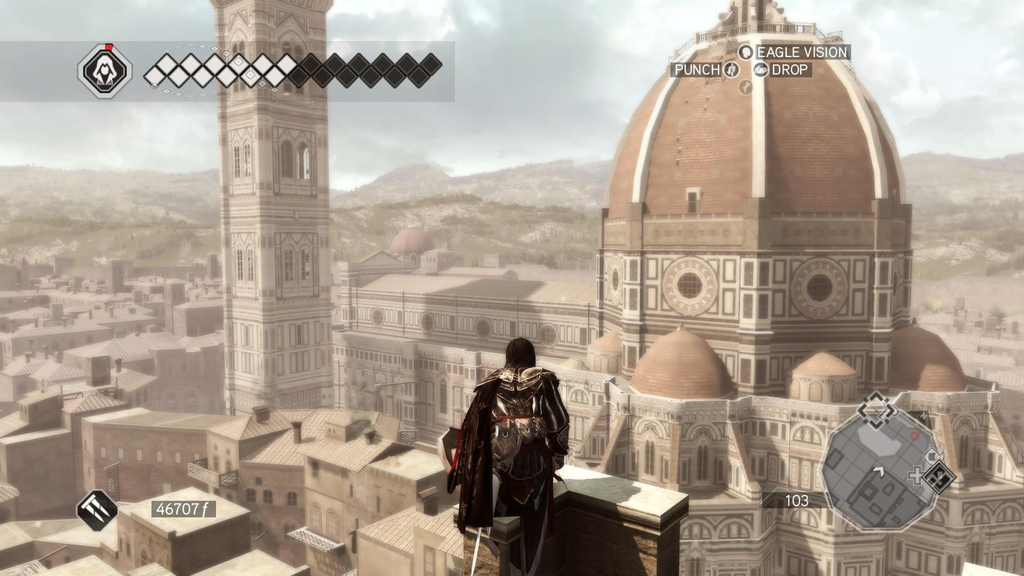
The sequel significantly expanded the mechanics of the first game, made the world more diverse, and became one of Ubisoft’s best-known projects. After it, the series regularly returned to different historical periods — from the Caribbean and its pirate themes to the French Revolution, Ancient Greece, Egypt, and England.
Thus, the main legacy of the first Assassin’s Creed was not only Altaïr’s specific story. The game established the foundation of a formula that Ubisoft could transfer to different historical periods: a large open world, city exploration, parkour, hidden assassinations, and historical context.
Today, the first Assassin’s Creed may seem simpler than later installments of the series. It has fewer activities, mechanics, and character progression options, while the mission structure is often repetitive. However, this very game laid the foundation for the franchise.
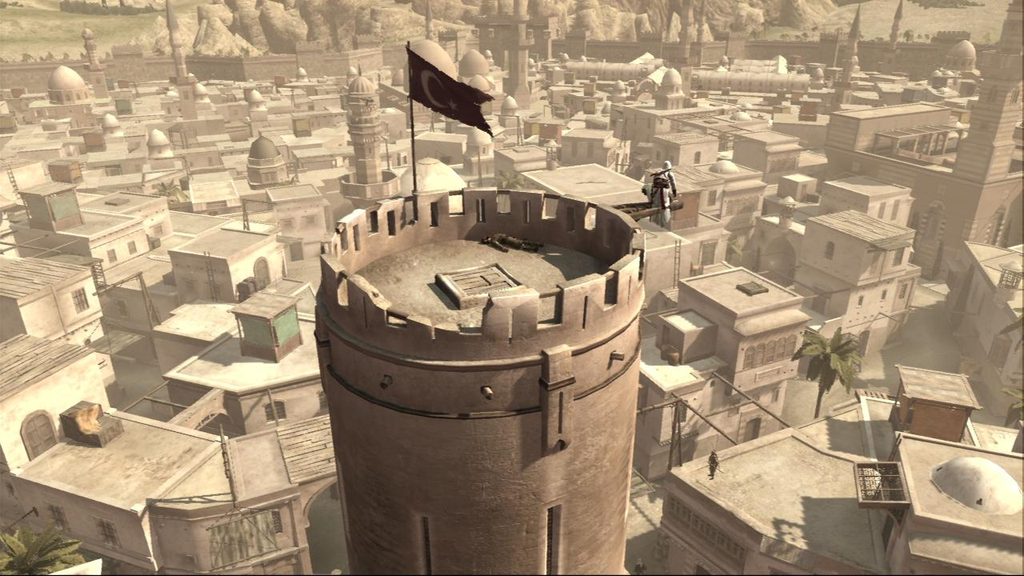
In 2007, Ubisoft showed that a historical world could be transformed into a large open space where architecture, movement, and exploration were no less important than story missions.
Assassin’s Creed became a successful debut for a new intellectual property and one of the key games of the PlayStation 3 and Xbox 360 generation. It launched a series that eventually became one of Ubisoft’s most recognizable franchises.
On November 13, 2007, Assassin’s Creed was only beginning its journey. But even then, it was clear that Altaïr’s story and the mysterious world of the Assassins could become much more than just one game.
As a reminder, PlayStation 5 — the history of the launch of the new-generation console.


