On August 25, 1997, GoldenEye 007 was released on the Nintendo 64 in North America — a game that initially looked like an ordinary licensed project based on a James Bond movie, but ultimately became one of the most important video games of the 1990s.
Today, GoldenEye 007 is remembered as one of the main projects that proved the viability of the first-person shooter genre on consoles. It didn't just port the Doom formula to the Nintendo 64 — Rare created a game with its own mission structure, stealth, diverse objectives, complex levels, and legendary four-player multiplayer. Over its lifetime, more than 8 million copies were sold, making it the third best-selling game in Nintendo 64 history.
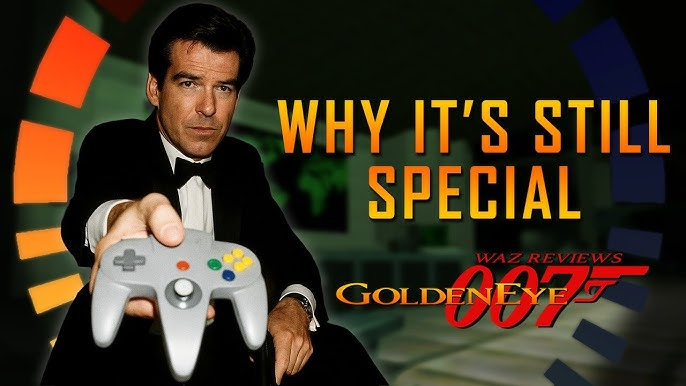
The story of GoldenEye 007 began back in January 1995, when Rare took on the development of a game based on the then-new movie GoldenEye. Martin Hollis — a young programmer who had little game development experience at the time — was tasked with leading the project.
And this is where the most interesting part begins.
The initial concept was entirely different from the game we know today. The project was planned for the Super Nintendo Entertainment System, and originally, it was supposed to be a side-scroller. Later, the concept transformed into a 3D shooter, after which Rare decided to target the upcoming Nintendo 64. Among the main sources of inspiration were Doom and Virtua Cop.
In the beginning, the team was very small. Hollis gathered programmer Mark Edmonds, artists Karl Hilton and B. Jones around him, and later other developers joined the team, including Duncan Botwood and David Doak.
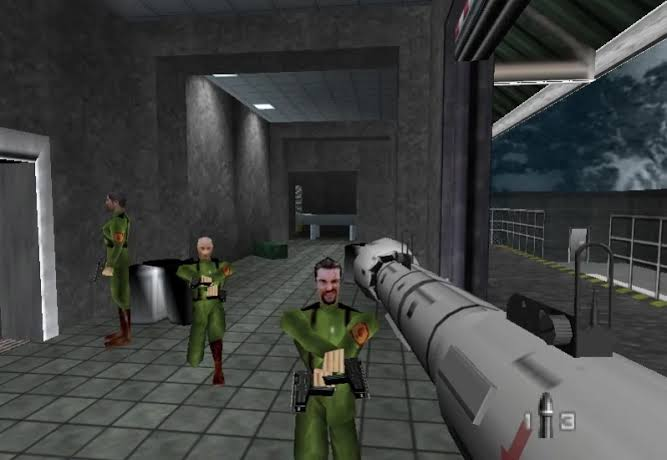
The first year essentially went into creating the game's technological foundation and graphical assets. The problem was that the Nintendo 64 was not yet a fully finished platform at that point. Rare lacked final specifications for the console and a complete set of development tools, so the team used an SGI Onyx workstation and effectively tried to predict the capabilities of the future system.
Interestingly, initially, no one expected major success from GoldenEye 007.
In the 1990s, movie tie-in games had far from the best reputation. Licensed projects were often rushed to make it in time for the movie's premiere, which is why they were frequently perceived as secondary products.
And GoldenEye was actually released two years after the movie's premiere. Meaning Rare didn't even have the advantage of releasing alongside the theatrical release.
Martin Hollis himself later recalled that the team was confident in their project despite the general skepticism surrounding movie-based games.
Development lasted approximately two and a half years, and the team ultimately consisted of about a dozen young specialists. The work was extremely intense, and after the project was completed, some team members faced professional burnout.
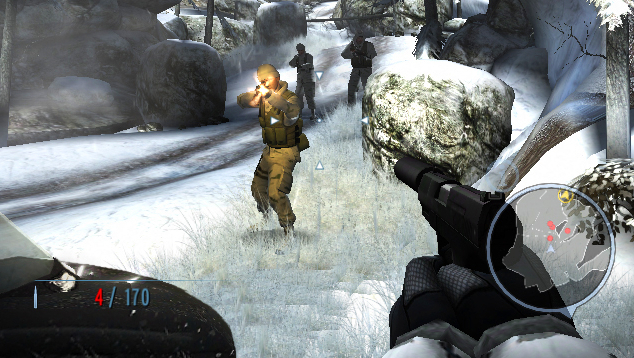
One of the main strengths of GoldenEye 007 was that Rare didn't simply try to recreate scenes from the movie.
Yes, the game featured familiar locations, characters, and plot points, but the developers were given the opportunity to expand the Bond universe.
The player didn't just run down corridors and shoot enemies. Missions had specific objectives: destroying objects, taking photos of evidence, rescuing characters, planting explosives, using gadgets, and completing other goals.
This is very important for the history of the genre. GoldenEye 007 showed that an FPS could be more than just a shooting gallery where the main goal is to eliminate all enemies. A level could require the player to explore, plan, use stealth, and complete specific objectives.
That is why the game felt more like a spy action film than a traditional arcade shooter.
And this is where GoldenEye 007 effectively became a legend.
Multiplayer was not a central part of the initial plan. It was added quite late in the development process. According to the developers, the team basically "crammed" the mode into the game, and after it appeared, the Rare staff themselves started playing it constantly.
On the Nintendo 64, up to four people could play simultaneously on a single TV using split-screen.
Today this might seem primitive. In 1997 — it was incredibly fun.
Four players could pick different characters from the Bond universe, run through familiar locations, use a variety of weapons, and hunt each other down.
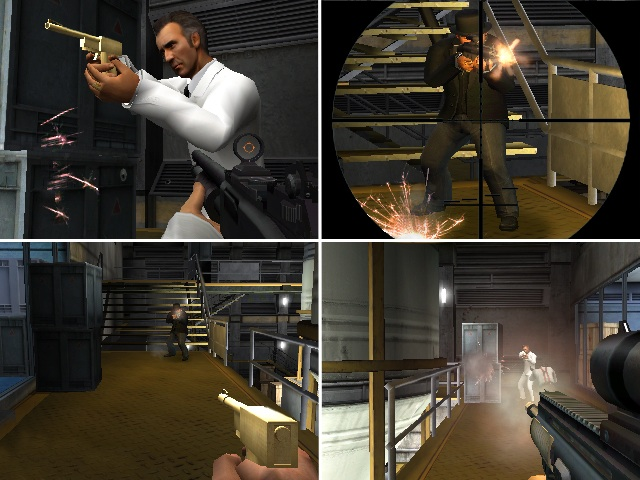
Thus, couch multiplayer culture was born — a situation where a group of friends gathers around a single TV and spends the evening playing games.
It was multiplayer that largely gave GoldenEye 007 its immense longevity. The game could be beaten in a few evenings, but after that, friends kept coming back to it again and again for matches.
Before GoldenEye 007, console FPS games existed, but the genre was primarily associated with the PC.
Doom, Quake, and other shooters showcased the capabilities of the keyboard and mouse, whereas console versions were often perceived as a compromise.
Rare proved otherwise.
In GoldenEye 007, controls via the Nintendo 64 controller became part of the game's design. The developers didn't just port a PC shooter to a console — they created an FPS specifically tailored for a console audience.
The game also showed that an FPS could work brilliantly with a story campaign, stealth, various mission objectives, and full-fledged local multiplayer.
In subsequent years, this approach became the foundation for many console shooters. GoldenEye 007 is often cited as one of the projects that paved the way for series like Halo and Call of Duty.
Critics received the game extraordinarily positively.
On Metacritic, GoldenEye 007 holds a 96/100 based on 21 critic reviews — all 21 reviews were positive.
Individual publications gave the game even higher scores:
In its time, GameRankings gave the game an average score of around 94.7%.
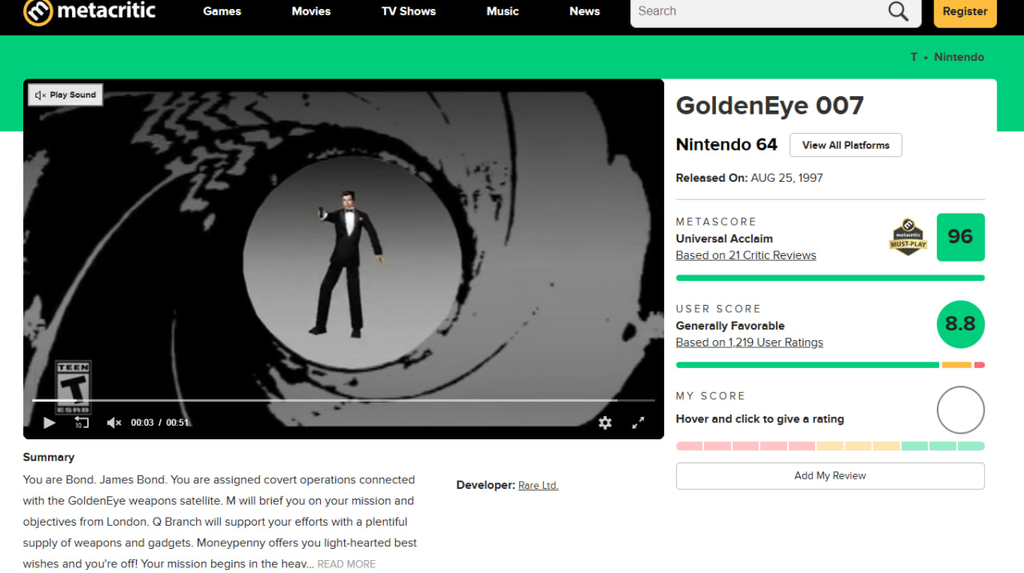
For a movie tie-in game, this was a phenomenal result. In the ranking of the best games of 1997, GoldenEye 007 was also among the absolute leaders with a score of 96/100 on Metacritic.
The most telling result was not the reviews, but the sales. GoldenEye 007 sold over 8 million copies, becoming the third best-selling Nintendo 64 game after Super Mario 64 and Mario Kart 64.
Moreover, the success was not instantaneous. The game gradually gained popularity through word of mouth and rentals. The Rare team monitored Blockbuster's rental charts and saw that numbers continued to grow even months after release.
For a game that was initially perceived as just another movie adaptation, this was a huge success.
Its impact can be seen across several areas at once:
Nearly three decades have passed, but GoldenEye 007 remains one of the most famous FPS games of its era. Its graphics and controls may seem archaic today, but that does not lessen the game's historical significance. It became an example of how a small team, given a license to a famous movie, managed to turn that material into something much greater.
On August 25, 1997, it wasn't just a James Bond game that came out. A game was released that helped convince the industry: a console can be a full-fledged platform for FPS games.
And its four-player battles on a single TV remained one of the brightest symbols of 1990s multiplayer gaming.
As a reminder: Hideo Kojima turns 63 — how one person changed the world of video games.


